

Reimagine Robotics emerges with AI factory training platform
Mon, 3rd Aug 2026.webp)
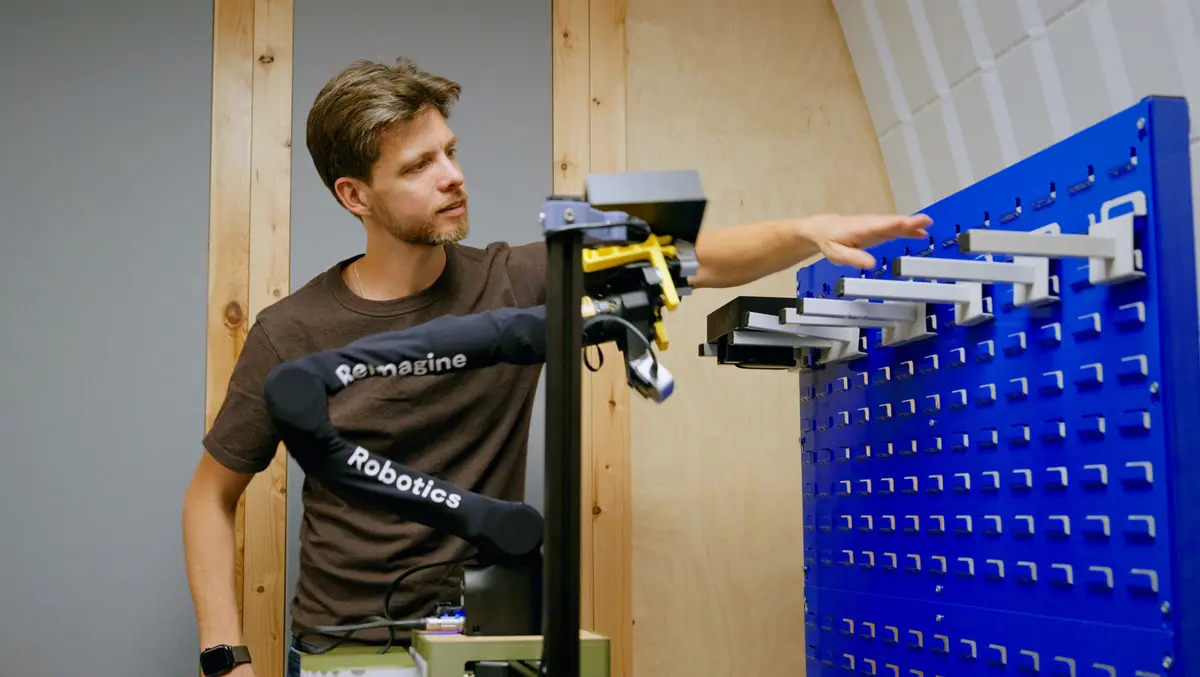
Reimagine Robotics has emerged from stealth with an AI robotics platform that lets workers train and correct robots without specialist programming. The company was founded by former leaders of Google DeepMind's Applied Robotics team.
The London- and Sydney-based business says its system lets workers teach robots directly on the factory floor, rather than relying on robotics specialists whenever a production task changes. Staff can show a robot a task, watch it attempt the work and correct errors as they appear.
Reimagine Robotics was co-founded in April 2025 by Jonathan Scholz, Oleg Sushkov, Akhil Raju and Misha Denil. Scholz previously built and led DeepMind's Applied Robotics team in London for seven years.
Its first phase was backed by pre-seed funding from Fly Ventures, firstminute capital and angel investors. The company is now seeking a new fundraising round as it expands deployments and hires staff.
Factory trials
Early deployments have focused on advanced manufacturing and electronics disassembly, with robots already operating in live environments.
At a made-to-order plastics manufacturer, Reimagine Robotics trained robots to tend 3D printers overnight. The work included removing print beds, operating latches and pressing controls.
The customer's own team then used the platform to automate further steps, including washing, curing and drying. That use case is central to the company's pitch: shop-floor staff can adapt robots themselves once the system is in place.
In another deployment, focused on recovering critical materials from used hard drives, the company worked with process engineers to create a three-robot disassembly cell. The workflow combined people and robots working together while adjusting the process in real time.
During that project, the time needed to prototype and test a new robot behaviour fell from about one day to around 10 minutes. That reduction allowed teams to try out new ideas for robot tasks almost immediately.
Founders' view
Scholz set out the company's central argument for industrial robotics.
"A useful robot should be able to learn from the person doing the work. They should be able to show it a task, put it right when it makes a mistake and move on to the next problem. That is what it means for a robot to learn on the job. It's a process we call 'monkey-see, monkey-do'," said Jonathan Scholz, Co-Founder and Chief Executive Officer of Reimagine Robotics.
He also described how the company believes robots should be introduced into workplaces.
"A robot should arrive with the attitude of a new colleague: 'How can I help? What do you want me to do?' The people who understand the process should be able to answer those questions by showing the robot directly," Scholz said.
The next step is to turn early customer trials into broader commercial use while building the workforce and raising more capital.
"We're excited to come out of stealth. This last year was about building a core product and a team, and working with customers to test the platform. After working with several partners, we're absolutely convinced it's not only viable, but that there is a need for this technology, and that it has massive potential across an array of industrial and manufacturing settings," Scholz said.
He also outlined how later deployments could benefit from earlier work.
"This next stage is about a new round of fundraising, expanding our team for more deployment muscle, putting robots into more workplaces, and showing that each deployment can make the next one faster, more reliable, and more efficient," Scholz said.
Human role
Reimagine Robotics says its model still depends on workers identifying problems and teaching machines how to handle repetitive physical tasks. It presents that approach as a way to keep operational knowledge with employees rather than shift it to outside programmers.
"For us, this is not about taking people out of the process. A robot that learns on the job depends on people. The worker identifies the bottleneck, shows the robot how to help and corrects it until it is useful," Scholz said.
He said the aim is to let workers hand repetitive work to machines while retaining oversight.
"The robot turns that person's knowledge into leverage. Instead of someone having to repeat a tedious physical task thousands of times, they can teach the robot, and apply that ability wherever it is needed," Scholz said.
"I think of it more as a tool to amplify human labour," Scholz said.