

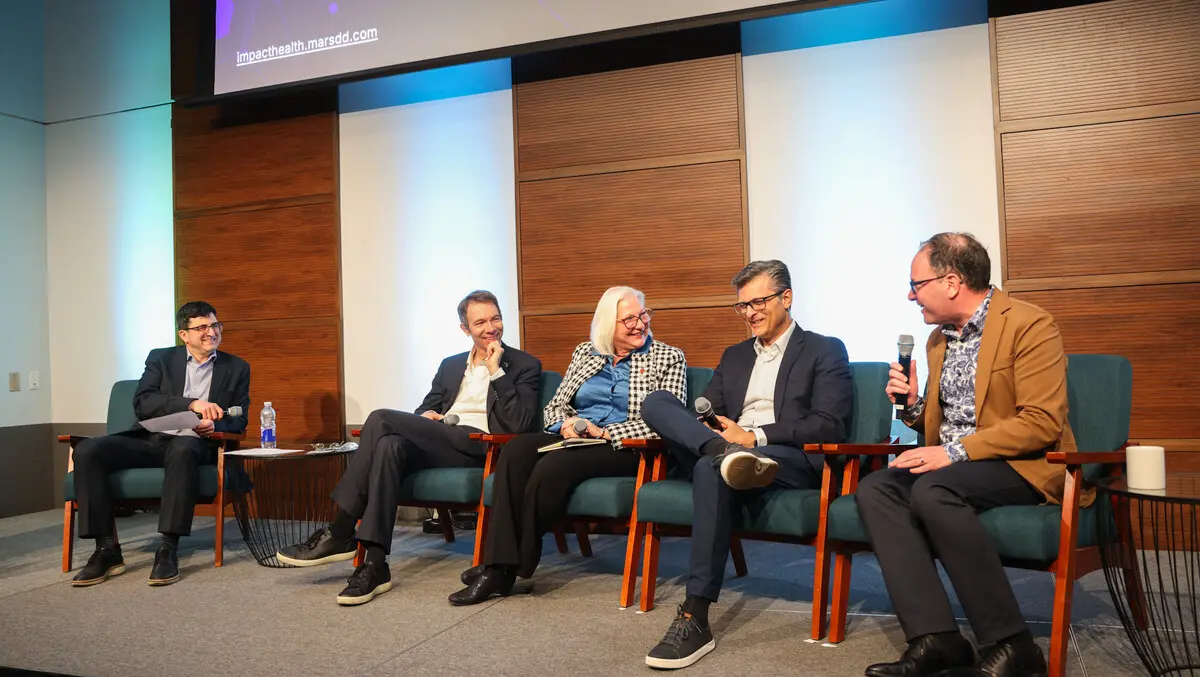
MaRS expert panel divided on Canada's health future
Mon, 27th Apr 2026
The great debate over Canada's excellence in technology talent and start-ups, but lacklustre performance in scale and acquisition, has made its way into the health tech sector.
At MaRS Discovery District's Impact Health conference in downtown Toronto last week, a panel was divided between a push for stronger domestic commercial execution alongside a long-standing tendency to prioritise global health outcomes over building homegrown industry scale.
Brian Bloom, Co-founder, Chairman, and Chief Executive Officer of the health investment firm Bloom Burton & Co, was in the latter category. He argued that Canada's private sector operates efficiently when there is a profit motive to bring new products and services to market, adding that while the deployment of Canada's health system is inefficient, it still contributes on the global stage.
"If I'm ever a patient on the table, don't give me the best Canadian whatever to cut me open. I want the best of the world - surgeons and tools and drugs and biologics and vaccines in my body - so that I can have my best life," said Bloom. "I don't want the best Canadian stuff. Please separate procurement. That's different for testing, prototyping, case studying and anything that can speed up healthcare."
Bloom, who runs a firm that invests in private-sector health tech ventures, stood in stark contrast to fellow panellist Wendy Zatylny, President and CEO of the Ottawa-based biotechnology industry association BIOTECanada.
Zatylny stressed the importance of public policy within innovation. She cited strides made by the current federal government, including the Health Emergency Readiness Canada fund, the new Pharmaceutical and Life Sciences Sector Task Force, and the 2026 Defence Industrial Strategy, which pointed to investments to establish and expand critical biodefence and medical countermeasures capacity.
"The two parts of industrial support are actually split, one from the other, and often work at cross purposes. What that looks like is certainly eliminating some of the regulatory slides, like streamlining regulations for approvals, whether it's clinical trials, drug approval processes," said Zatylny. "I think the big thing that we've got to deal with, though, is essentially finding a mechanism that unites industrial policy with procurement, because the healthcare sector and pharmaceuticals is unique, probably from any other sector,"
Data silos are one aspect of the fragmented industry, added Mamdani, Clinical Lead, Artificial Intelligence at Ontario Health and University of Toronto professor.
"Governments now are aggressively trying to get together their strategies around, 'how do we actually consolidate these things?' Because these AI technologies are being adopted very slowly, now we're seeing more rapid adoption. We got to get ahead of it, get on the idea. Right now we're very far behind it," said Mamdani.
He pointed to early, real-world deployments of AI in hospital settings as evidence of its impact, citing a system his team developed that monitored patients hourly alongside clinical staff. The system, he said, showed a 26 per cent reduction in unexpected adverse events, based on observed outcomes rather than projections, demonstrating both cost savings and tangible improvements in patient care through AI.
Despite his ambition for a global-centred scaling focus, Bloom emphasised the ingenuity of Canada's research capabilities.
"When it comes to what government can do, it should continue to fund academic research on University Avenue and across Canada, because that's the fruit of what all the entire global biotech industry relies on for its ideas, for its discoveries, and then for commercialisation, which is a private sector activity."
Bloom argued that government support should remain indirect, favouring mechanisms such as matching programs and fund-of-funds structures that channel capital through private investors rather than selecting individual companies. In his view, initiatives that expand the capacity of established venture funds are more effective and less risky than attempts to pick winners, maintaining a necessary degree of separation between public funding and commercial decision-making.
Mamdani pointed to a structural challenge within academia, arguing that researchers are still primarily rewarded for publications and grant funding rather than for commercialising their work. While universities are beginning to broaden how they evaluate impact, it will take time to shift thinking, even as increased investment in academic institutions remains essential to sustaining innovation.
"I think resources need to be put into the academic organisations that actually drive a lot of these innovations. But I would also say that the culture shift is going to take a bit more time," said Mamdani.
BioLabs Founder and CEO Johannes Fruehauf, whose company just opened the city's largest shared lab incubator with U of T, was another panellist. He added that health tech needs lab space, but community is also important - an advantage Toronto specifically needs to take more advantage of its high density of world-class hospitals.
The moderator, The Globe and Mail's technology reporter Sean Silcoff, summed up the panel. "The summary is, be hungry and don't worry."