


Snowflake debuts tools to govern & scale enterprise AI
Tue, 3rd Feb 2026.webp)
Snowflake has launched a new service called Semantic View Autopilot and set out a broader set of product updates aimed at taking enterprise AI work from experimentation into production.
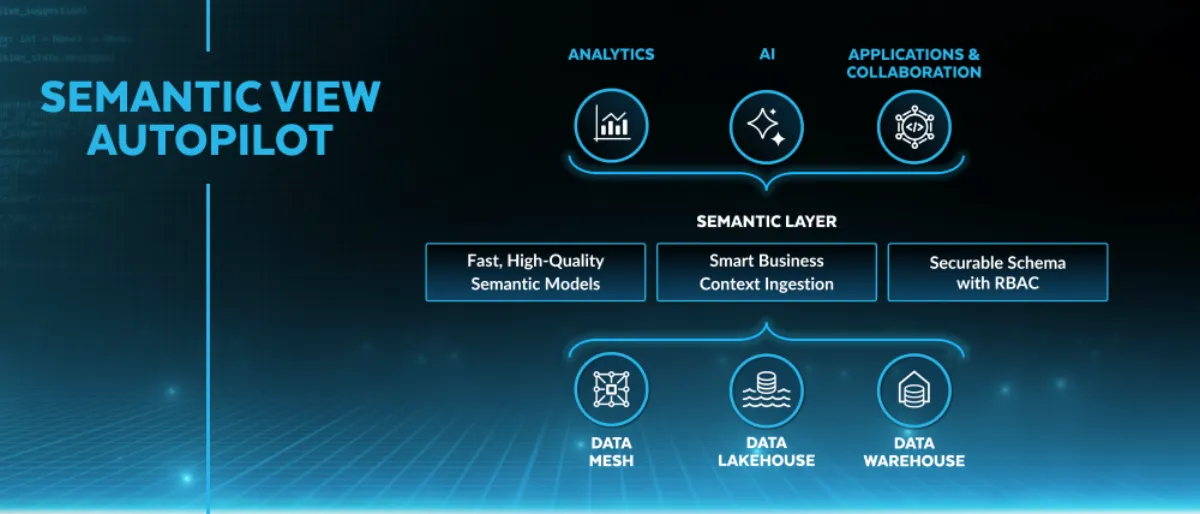
The company announced that Semantic View Autopilot is now generally available. Snowflake described it as an AI-powered service that automates the creation and governance of semantic views. Snowflake said the service gives AI agents a shared understanding of business metrics. It said this approach reduces inconsistency in business logic across tools and teams.
Snowflake also introduced updates across agent evaluations and observability, machine learning development and deployment, and AI cost governance. Some of those features are generally available, while others are expected to become generally available soon.
Snowflake positions the semantic layer as a key requirement for reliable AI output. Enterprises often define business metrics manually. Those definitions can vary by department, system, or dashboard. Snowflake said this lack of consistency creates a bottleneck when organisations attempt to deploy AI agents against business data.
Semantic layer
Snowflake has announced the launch of Semantic View Autopilot, a new service designed to automate the construction, optimisation, and maintenance of governed semantic views.
According to the company, the tool significantly reduces the manual labour typically required for semantic modelling by streamlining the creation of data structures. The service is built to integrate seamlessly with existing business definitions already stored within Snowflake or across various third-party business intelligence tools utilised by its customers.
The release of Semantic View Autopilot is closely tied to Snowflake's broader initiative, Open Semantic Interchange (OSI). Snowflake describes OSI as a collaborative effort to establish an interoperable semantic layer that functions across different technology providers, ensuring consistency in how data is defined and accessed.
By incorporating automation and ongoing maintenance into this framework, Semantic View Autopilot aims to provide a more resilient and scalable approach to data governance and enterprise analytics.
Snowflake said the service learns from real user activity and uses AI-driven generation. It said it will keep business logic accurate and up to date across Snowflake data and consumption tools. It listed dbt Labs, Google Cloud's Looker, Sigma, and ThoughtSpot as tools in scope. Snowflake said availability for some integrations is coming soon.
The company said customers can cut semantic model creation from days to minutes. It said the approach reduces AI hallucinations by anchoring agents and analytics tools on shared, governed definitions of business metrics.
Snowflake named eSentire, HiBob, Simon AI, and VTS as organisations already using Semantic View Autopilot.
"AI is quickly becoming part of the operating fabric of the enterprise, not a side project," said Christian Kleinerman, EVP of Product, Snowflake. "Our focus is to make that future a reality now by ensuring AI agents operate on consistent business logic, behave as expected, and scale without surprises. By unifying trust, governance, and execution on one platform, we're delivering AI that actually works in the environments our customers care about."
Snowflake also highlighted customer use of the semantic layer in AI applications. "At Simon AI, our focus is helping businesses turn data into real, actionable outcomes. But inconsistencies between business logic have historically slowed how far AI can be applied," said Matt Walker, CTO at Simon AI. "Semantic View Autopilot provides our AI systems with a consistent, governed understanding of business metrics that we can collaborate upon with our customers. This allows us to deliver reliable personalization and AI-driven engagement that our customers can trust to drive measurable results."
ML workflow
In machine learning, Snowflake said Snowflake Notebooks is now generally available. It described the product as a fully managed Jupyter-based notebook environment for data science and ML development that runs on Snowflake data.
Snowflake said Snowflake Notebooks integrates with Cortex Code, which it also said is now generally available. Snowflake described Cortex Code as a coding agent for development work within the platform. It said users can write prompts in natural language and generate ML pipelines from within the notebook environment. It said this reduces manual effort in development workflows.
The company also announced that Experiment Tracking is now generally available. Snowflake said the feature lets teams compare training runs, share results, and reproduce models from within Snowflake Notebooks.
For production deployments, Snowflake said Online Feature Store and Online Model Inference are now generally available. It said these features support real-time use cases. It said features can be served in milliseconds and predictions can be delivered at scale. Snowflake said the model lifecycle remains within its platform, including governance from data through to model output.
Snowflake cited Aimpoint Digital as an enterprise using Snowflake Notebooks for ML projects. It said use cases include personalisation, fraud detection, and predictive analytics.
Agent checks
Snowflake also outlined Cortex Agent Evaluations, which it said will be generally available soon. The company said the feature makes agent behaviour traceable, measurable, and auditable. It said developers can assess answer correctness, tool use, and logical consistency.
Snowflake said Cortex Agent Evaluations provides visibility into how agents reason, act, and respond. It said teams can identify errors and validate whether agents behave as intended before deployment into business workflows. Snowflake also said the feature can reduce operational waste from redundant tool calls and escalating compute consumption.
Snowflake named WHOOP as an enterprise using Cortex Agent Evaluations within Snowflake. It said the customer uses it to improve agent quality without moving data to external monitoring tools.
Cost controls
Alongside product releases aimed at reliability and deployment, Snowflake also expanded cost governance features within Cortex AI Functions, which it said are now generally available. Snowflake said organisations can plan, control, and audit AI usage. It also highlighted a function called AI_COUNT_TOKENS. Snowflake said teams can estimate consumption before running workloads and assess how prompt design and context size affect cost.
Snowflake said the new releases form part of its wider approach to governed AI work on enterprise data, including deployments of AI agents and machine learning pipelines in production environments.