

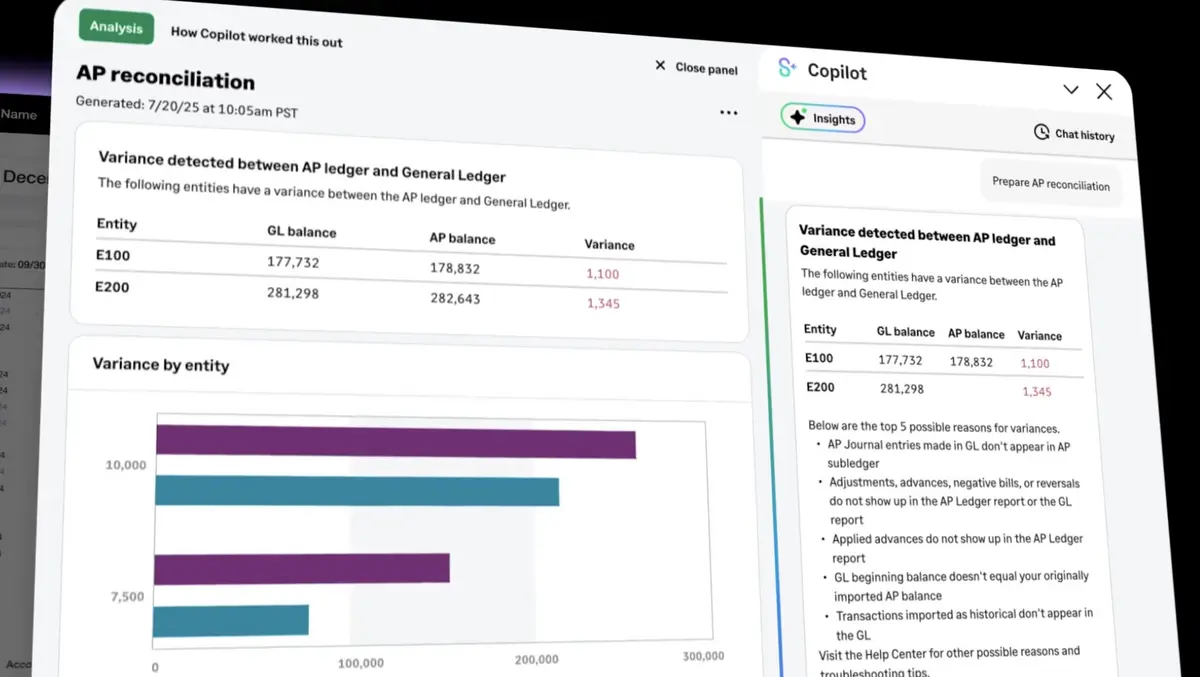

As AI becomes more embedded in accounting workflows, Sage Intacct is emphasising visibility into decision-making.
Jon Fasoli, Senior Vice President at Sage Intacct, told TechDay that Sage's approach to AI is rooted in its reputation in financial systems, where reliability has historically been a core requirement. Rather than treating trust as a new challenge introduced by AI, the company is framing it as an extension of its legacy strengths.
"I think the way that Sage does that is with trust, and what gives us the right to prove that is the 40-plus years of proof across the products," said Fasoli.
Central to Sage Intacct's AI strategy is its Finance Intelligent Agent (FIA), which has evolved since its initial release last fall to support more complex workflows and actions. Initially designed to answer questions about financial data, the agent is now increasingly embedded in operational processes.
"You measure better based on those trust metrics - the accuracy, having to do with the confidence; the control, having to do with the audit log - and then the team has both actions," said Fasoli.
The system now supports actions such as accounts payable approvals, alongside enhanced interfaces that allow users to interrogate how outputs are generated. These include visual layers that break down reasoning and enable users to drill into underlying data in real time.
This reflects a shift from passive AI assistance towards more active, decision-supporting systems that operate within defined parameters.
Talent pressure
As Sage announces the expansion of Sage Intacct AI capabilities as efficient and honest accelerators, it is also described as a way for organisations to combat accounting talent shortages, as Chartered Professional Accountant numbers are dropping. The U.S. Bureau of Labor Statistics reported in 2024 that job openings for accountants and auditors will grow by 4% between 2022 and 2032, as workers retire or leave the profession.
A report by the National Pipeline Advisory Group stated that accounting degree completions fell 17%, from 75,153 in the 2017–2018 year to 62,318 in 2021–2022, according to the Integrated Postsecondary Education Data System.
A longstanding shortage of qualified accountants is increasing pressure on organisations to do more with fewer resources, added Fasoli.
Glass box approach
A key element of Sage's positioning is its "glass box" approach to AI, which contrasts with "black box" systems that offer limited visibility into their internal processes.
The concept centres on making AI outputs explainable and traceable, allowing users to understand not just what decision was made, but how it was derived. This includes exposing calculations, data sources and intermediate steps in a way that can be audited.
"The ability to explain why or explain how we're calculating everything is about providing confidence," said Fasoli. "Part of the experience is really just your permissioning. Ensuring that the agent is held to the same permissions that you apply to people on your team. Then there's a big platform component that's very difficult and sophisticated that we built in order to bind that agent to the same permissions."
This transparency is designed to mitigate one of the most widely cited risks in generative AI: hallucinations. By surfacing the underlying logic and inputs, Sage aims to reduce the likelihood that users act on incorrect or unsupported outputs.
The system also signals uncertainty where appropriate, rather than presenting all responses with equal confidence. In cases where multiple outcomes are possible, users are informed and given additional context to support decision-making.
"We have several layers of AI that basically assume routing ... and it will understand the confidence level of the path that we put it on. So if we can calculate with a high enough degree of certainty that there's a specific endpoint or set of endpoints to serve an answer back with then thats going to feel like a great agentic experience," added Fasoli. "If we put you on a path where we think there's probability that could be more than one answer, then we expose that to the customer - we're transparent to say, 'hey, just so you know, this is a guess.'"
The architecture also accounts for the growing use of third-party integrations, ensuring that external agents interacting with Sage systems adhere to the same security and access policies.
"The most important part of the customer experience there is the audit log - not just showing what the agent did, but who gave it the task and who approved the task," said Fasoli.