

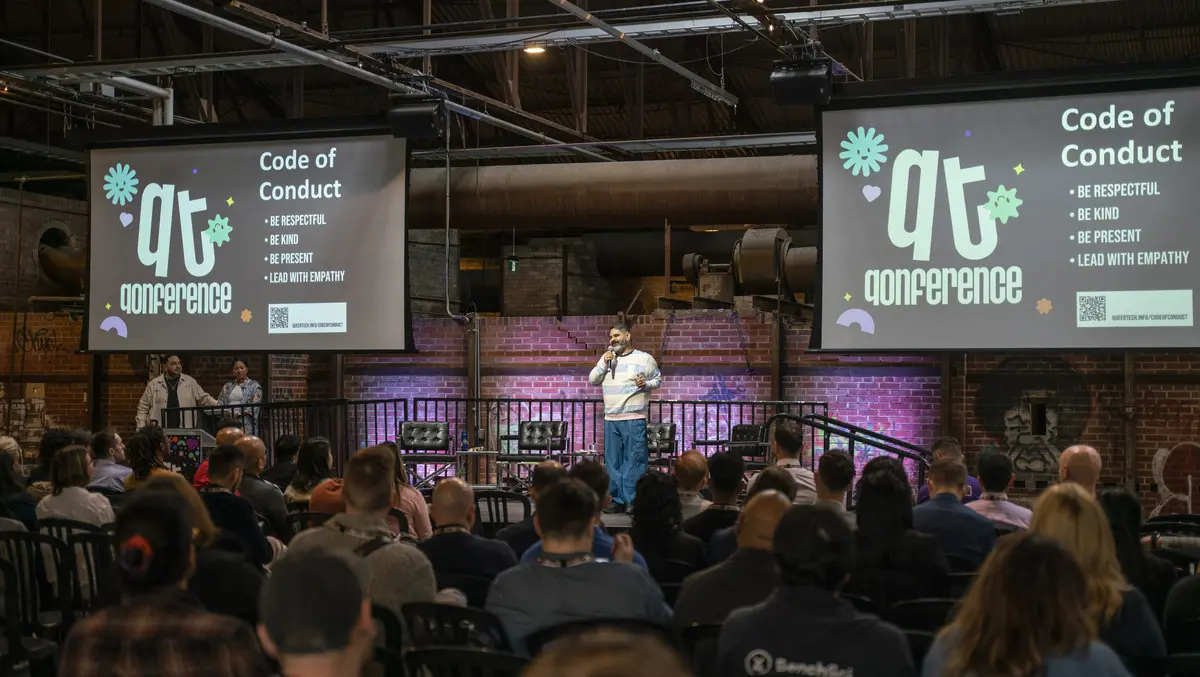

QueerTech is looking to shape Canadian workplaces so that inclusion is not just a checkbox but a foundational standard in tech.
Founded in 2016 by tech leaders Eustacio Andy Saldaña and Naoufel Testaouni, the Montreal-based non-profit has three main branches, including an access program for early-career transitions, a leadership-oriented program helping people break through the mid-level leader ceiling, and a founders track.
This year, QueerTech launched its Certified Inclusive Tech survey. Funded by Women and Gender Equality (WAGE) Canada, the survey, which interviewed over 40 individuals from tech organisations, is an initial step to map out where gaps lie in 2SLGBTQ+ inclusivity among Canadian workplaces and how to deploy digital guardrails in tech.
Co-founder and CEO Naoufel Testaouni told TechDay that they are working to build a future where AI advances equity, not bias.
"We're just repeating the past into tech. And we don't want that. We don't want to get our communities to be more excluded also in technology," he says. "So that's why we're getting involved, because we want to educate companies around inclusive AI and how to implement it throughout the AI development process."
Testaouni says the survey was conducted within QueerTech's community of over 10,000 members and 100 organisations, focusing on qualitative interviews rather than large-scale sampling. The collected data will be used to develop resources, such as workshops and toolkits. He adds that through this in-depth method, the survey laid the foundation for subsequent efforts to focus on key areas affecting the community.
QueerTech's survey found that while a third of organisations have a formalised commitment to address bias and encourage diverse representation, only 9.5 per cent have comprehensive processes to identify and address potential biases in AI systems - whether through stereotyping, exclusionary recommendations, or underrepresentation in outputs.
As part of the inclusivity program, the efforts will focus on two tracts: project managers, including AI developers, and the human resources function. Amos Teo, QueerTech's Data Insights & Impact Strategist, says the latter is adopting AI rapidly and faces the highest risk of exclusion of 2SLGBTQ+ people.
"[The survey asked] when you're training the model with the data that you have, what's missing, whose voices are incorporated there into the model training side?" he says. "With the product, are there guardrails against hate speech and things that might be very exclusionary, that might affect disproportionately affect some groups and not others."
57.1 per cent of respondents believed that diverse training data is essential to avoid bias and improve outcomes. In comparison, only 22.2 per cent rated their organisation's performance in having diverse and representative training data as "Good" or "Very Good."
"The main challenges that they're fighting are insufficient resources or budget, competing priorities and deadlines, and lack or lack of awareness and knowledge. But mostly insufficient resources, as well as a lack of prioritisation," added Teo.
As part of funding from WAGE, QueerTech will focus on delivering a self-assessment tool to help AI developers identify and address potential bias in new systems and applications, as well as toolkits for organisations to build and incorporate these foundations into their products and services.
Testaouni says the organisation is looking to release a more in-depth report in the first quarter of next year, using the assessment tool to gauge how people and workplaces are using AI.
"We need to jump on putting some guardrails up before this problem is even bigger. And so hopefully [we can do that] through raising awareness with companies and doing a little bit more research to bring data to the government."