

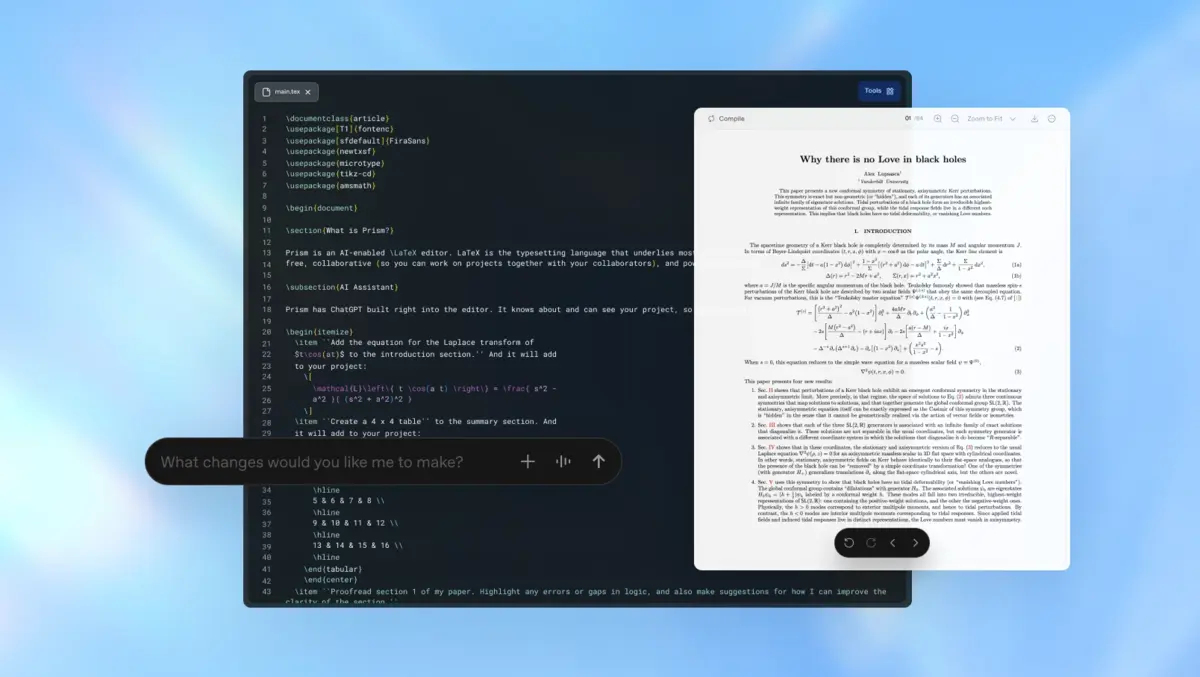
OpenAI launches Prism, free AI-native LaTeX workspace
Wed, 28th Jan 2026
OpenAI has launched Prism, a free cloud-based workspace for scientific writing and collaboration that integrates the company's GPT-5.2 model into LaTeX projects.
The product is available to anyone with a ChatGPT personal account. OpenAI said Prism will also become available to organisations using ChatGPT Business, Enterprise and Education plans.
OpenAI positioned Prism as a response to fragmented research workflows. It described common day-to-day research tasks as split across editors, PDFs, LaTeX compilers, reference managers and separate chat tools. The company said that pattern interrupts focus and causes researchers to lose context.
LaTeX workspace
OpenAI described Prism as "AI-native" and "LaTeX-native". It said the workspace combines drafting, revision, collaboration and preparation for publication in one place. GPT-5.2 sits inside the project rather than running as a separate assistant. OpenAI said this gives the model access to the structure of a paper, equations, references and surrounding context.
The company said Prism builds on Crixet, a cloud-based LaTeX platform that OpenAI acquired and later developed into Prism. OpenAI said it started with an existing writing and collaboration environment and then added AI features within the workflow.
OpenAI listed a range of functions tied to GPT-5.2 in Prism. It said researchers can use chat with "GPT-5.2 Thinking" for scientific reasoning inside a project context. It also said users can draft and revise a manuscript with the full document available as context, including equations, citations, figures and overall structure.
Litreature search
OpenAI said Prism can search for and incorporate relevant literature, including material from arXiv, inside the context of a current manuscript. It said the tool can support revisions after identifying related work.
The company also said Prism can create and refactor equations, citations and figures while tracking how those elements relate across a paper. It said users can convert whiteboard equations or diagrams into LaTeX. It said this can reduce time spent manipulating graphics.
Prism also includes collaboration features. OpenAI said research teams can work together in real time, with edits, comments and revisions reflected immediately. It also said users can request direct in-place changes to documents without copying content between separate editors and chat interfaces.
OpenAI said Prism includes optional voice-based editing for simple changes during writing and review.
Collaboration model
OpenAI has made Prism available with unlimited projects and unlimited collaborators. The company framed this as a way to avoid seat limits for research teams working across institutions and geographies.
It said the cloud-based approach removes the need for local LaTeX installation and environment management. OpenAI also said this reduces version conflicts and manual merging.
Pricing approach
OpenAI said Prism is free to use for anyone with a ChatGPT account and that there are no subscriptions or seat limits. It also said more powerful AI features will become available through paid ChatGPT plans over time.
The launch adds to OpenAI's push to embed its latest models inside specific professional workflows, rather than positioning the chatbot as a separate interface. Scientific writing and coordination sit alongside other domains where companies have been exploring AI-based assistants in document creation and knowledge work.
OpenAI also linked the release to its wider view of how AI could change research practices, with an emphasis on removing friction in everyday work rather than focusing only on experimental design and analysis.
OpenAI said Prism will expand to organisations on ChatGPT Business, Enterprise and Education plans soon.