

Meet the B.C. startup using AI to preserve fading languages
Mon, 1st Dec 2025
From Canada and across the world, thousands of languages are under threat of disappearing. Many Indigenous languages, primarily oral, are surviving only through an ageing population of speakers.
One Canadian startup is using technology to help preserve and teach these languages, turning AI into a bridge between generations.
Language Foundry has developed a platform designed to make language revitalisation more accessible. With a team of 12 strong, spread across Canada from Victoria to Toronto, the startup has grown from a small experiment to a platform now supporting 14 languages and dialects. Current offerings include those of the Anishinaabe, Maliseet, and Cree peoples.
Brought up in B.C., founder Chad Quinn's inspiration for the project traces back to his childhood on Thetis Island, where he connected with Indigenous peers. Years later, while reading a research paper from [University of British Columbia (UBC)], he encountered a startling statistic: reconnecting young people with language and culture can reduce suicide rates and truancy by up to 50 per cent.
"That was the spark," he recalls. "Okay, there is a major social impact that you can have if you were able to support this in some way."
A key challenge Language Foundry is looking to address is the oral nature of many Indigenous languages. "It's a race against time," Quinn notes. With many fluent speakers in their 70s or 80s, capturing knowledge before it's lost is urgent.
The organisation developed a system for remote language recording. Selected community members receive recording kits, and a support team guides them through the process, while linguists build a corpus from the data.
The platform harnesses AI-generated voices trained from a minimal number of recorded hours. Quinn says, "We've gone from 15 hours of recorded speech down to about an hour or two for a new voice." More languages preserved, faster using AI.
The web platform combines C# and Blazor for the interface, Python for text-to-speech processing, and Unity for interactive learning games. SQL Server databases underpin the system, with innovations like a proto-language to avoid English bias in data processing.
These voices are integrated with avatars, enabling learners to hear and interact with the language more authentically. As more hours of a language are logged, the model develops a more sophisticated understanding of the language, which is then passed on to users. The curriculum itself, created entirely by community members, can span hundreds of hours.
Early development began with concatenation models, but the team quickly moved to neural models for more natural speech. Collaboration with UBC refined the training process, using a catalogue of phonetic sounds from 100 languages as a base.
"We train on top of that using, let's say, a dialect of Cree. We'll train a smaller subset of the Cree language because we're able to leverage all the sounds of speech for all languages," he says. "We've also gone from single speaker to multilingual speak multi speakers, so multiple people can each contribute a smaller amount."
Language Foundry typically hires two to four community speakers for each project, depending on the community. These speakers are responsible for creating the actual curriculum. For example, the initial curriculum for Anishinaabemowin targeted roughly grade nine and ten students and spanned 120 hours of instruction. It is now being expanded to 240 hours, reflecting the depth and richness of the language.
The first beta version of the platform launched three years ago in Northern Ontario, partnering with local organisations to test its effectiveness. "The reaction was 'Can you do more of this?' and we pushed ahead of schedule," Quinn explains.
Today, the platform has roughly 10,000 users learning Indigenous languages.
Anyone can create a free account and start learning at their own pace. Language Foundry is designed to serve both school boards and independent learners (with professional tools for classrooms that are subscription-based).
Quinn emphasises that the startup's role is not to revitalise languages directly. "It's the communities that are creating the content and are doing the heavy lifting when it comes to revitalising language," he says. "We're just here to make it a little bit easier and make the tools more accessible for folks."
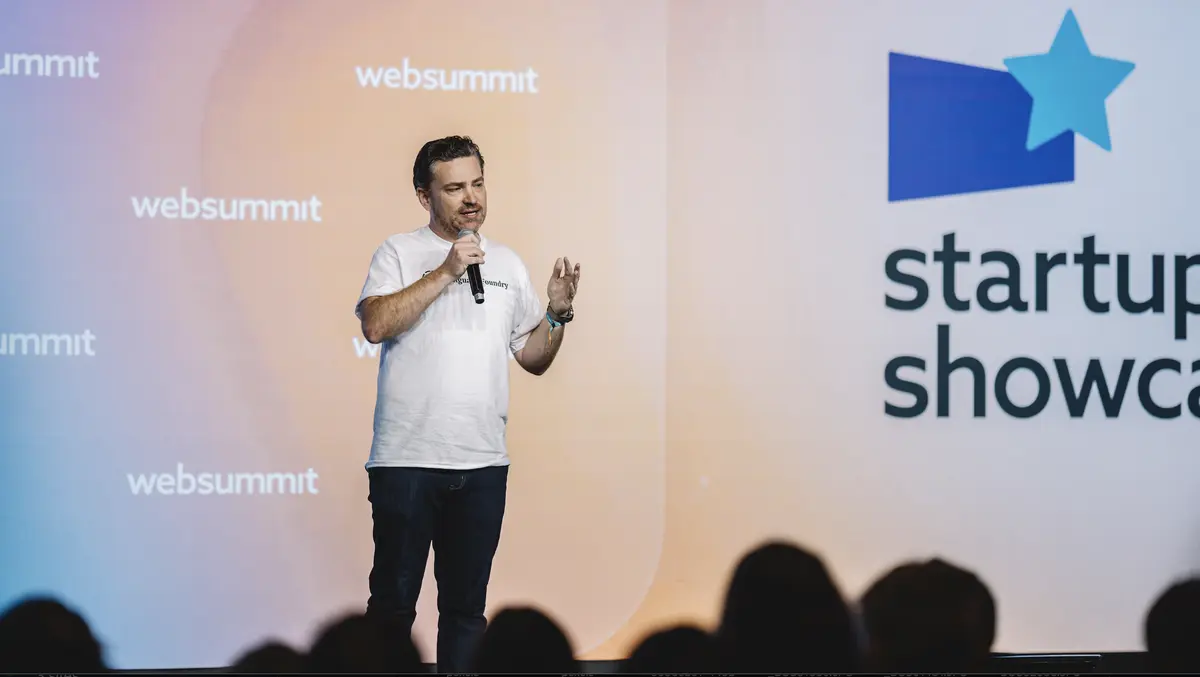
Recently, the platform has earned recognition beyond Canada. At this year's Web Summit in Lisbon, the team showcased the platform to a global audience, revealing strong demand for tools for endangered languages worldwide. Quinn sees potential to expand into other languages facing extinction, with AI and technology providing a scalable solution when traditional resources are scarce.
"We want to capture knowledge before it's lost, and make it accessible for everyone," he says. "We just see ourselves as tool builders, really."