

Honeywell tests aerospace cooling module for AI data centres
Mon, 2nd Nov 2026 (Today)
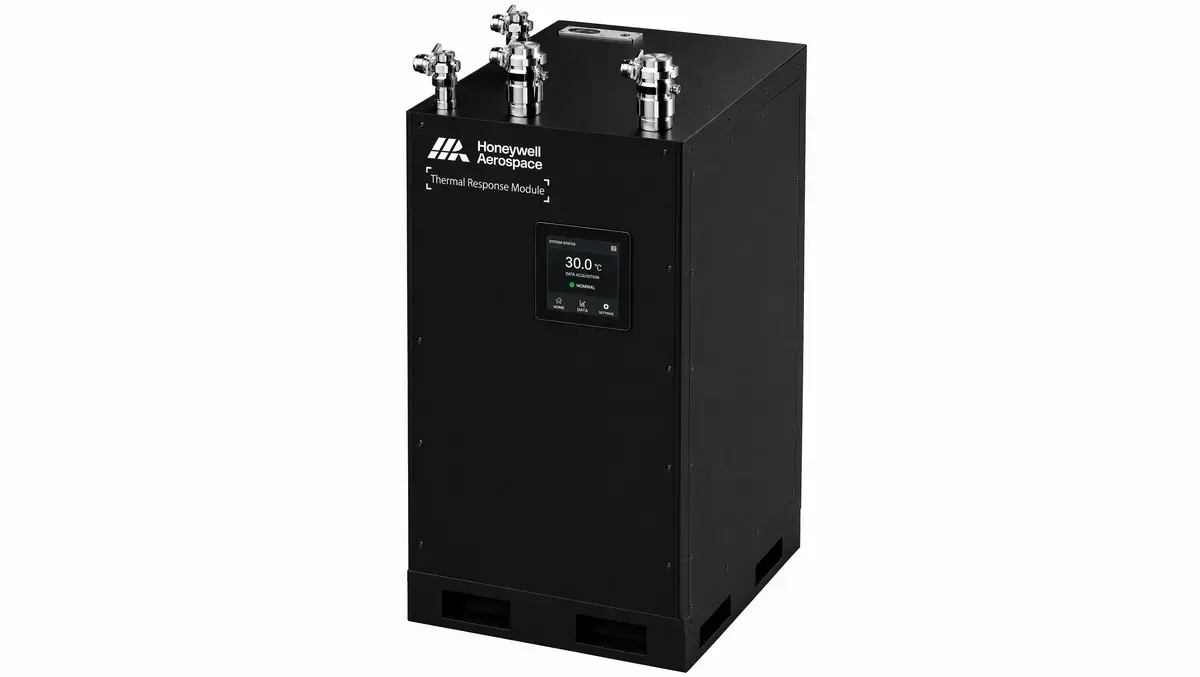
Equinix has tested and installed Honeywell Aerospace's Thermal Response Module at its Co-Innovation Facility in Ashburn, Virginia.
The installation marks Honeywell Aerospace's move to apply thermal management technology from aerospace and defence to AI data centres.
The module is designed for liquid-cooled AI infrastructure, where operators are under pressure to manage rising heat loads from denser computing systems. Brief interruptions or fluctuations in cooling can affect graphics processing unit performance and expose expensive hardware to damage, according to Honeywell.
The system acts as a thermal buffer within a cooling loop. Installed between the coolant distribution unit and servers, it is intended to keep coolant temperatures stable during power disturbances, sudden shifts in compute demand, or changes elsewhere in the cooling system.
Honeywell said the unit uses phase-change materials to store and release thermal energy as needed. That approach provides an immediate response while the wider cooling system adjusts, it said.
Cooling pressure
The announcement comes as AI infrastructure is reshaping data centre cooling design. Operators are increasingly adopting direct-to-chip liquid cooling to support more powerful processors, prompting vendors to develop equipment that can maintain stable temperatures during short-term disruption.
According to Omdia, some form of liquid cooling is deployed in fewer than half of data centres. The research firm expects the market to grow at an annual rate of 20% over the next five years.
Honeywell said its Thermal Response Module can be integrated into existing cooling loops without redesign and does not depend on a specific coolant distribution unit supplier or architecture. It added that the system can be scaled from edge deployments to larger AI clusters.
Honeywell also said the module delivers 7.6 times more cooling power than chilled water, stabilises the cooling loop within seconds, and can be expanded to support several minutes of thermal buffering. The company said this could help operators avoid temperature excursions and reduce service-level agreement risk.
Testing took place at Equinix's Ashburn facility, which it uses for development and evaluation work. Equinix said the trial examined how the technology handled rapid changes in GPU cooling demand.
"We are pleased to have collaborated with Honeywell Aerospace on the development and testing of the Thermal Response Module," said Pawel Wlodarczak, Design Innovation Director, Global Design, Equinix. "Testing at our Ashburn Co-Innovation Facility demonstrated the technology's capability to manage rapid GPU cooling load fluctuations while requiring a smaller footprint compared with buffer tanks. As AI deployments continue to scale, innovations such as this will help address critical cooling and infrastructure challenges."
Aerospace crossover
Honeywell Aerospace said the product reflects a broader effort to apply thermal management work developed for aircraft and defence systems to adjacent markets. While aerospace platforms and AI data centres operate in different settings, both depend on precise temperature control to protect equipment and maintain continuous operation, it argued.
That crossover is becoming more relevant as AI data centres consume more power and pack more compute into the same footprint. In those conditions, cooling systems have less room for error, and operators are looking for ways to keep servers online during short disturbances without overhauling existing infrastructure.
Honeywell said the module includes onboard state-of-charge sensing alongside its heat exchanger design and phase-change materials. These features are intended to improve temperature stability and support more consistent operation of chillers, coolant distribution units, and other upstream cooling assets, it said.
Rich DeGraff, President and Chief Executive Officer, Control Systems, Honeywell Aerospace, said the company sees direct parallels between mission-critical thermal control in aerospace and the demands now emerging in AI facilities.
"AI workloads are pushing data centre thermal systems harder than they were designed to run," said DeGraff. "We have taken phase-change material technology developed to protect mission-critical aerospace and defence systems and applied it to a similar challenge in AI infrastructure. Our work with Equinix shows how proven aerospace technology can help data centre operators protect critical hardware, sustain performance, and reduce the risk of disruption."