

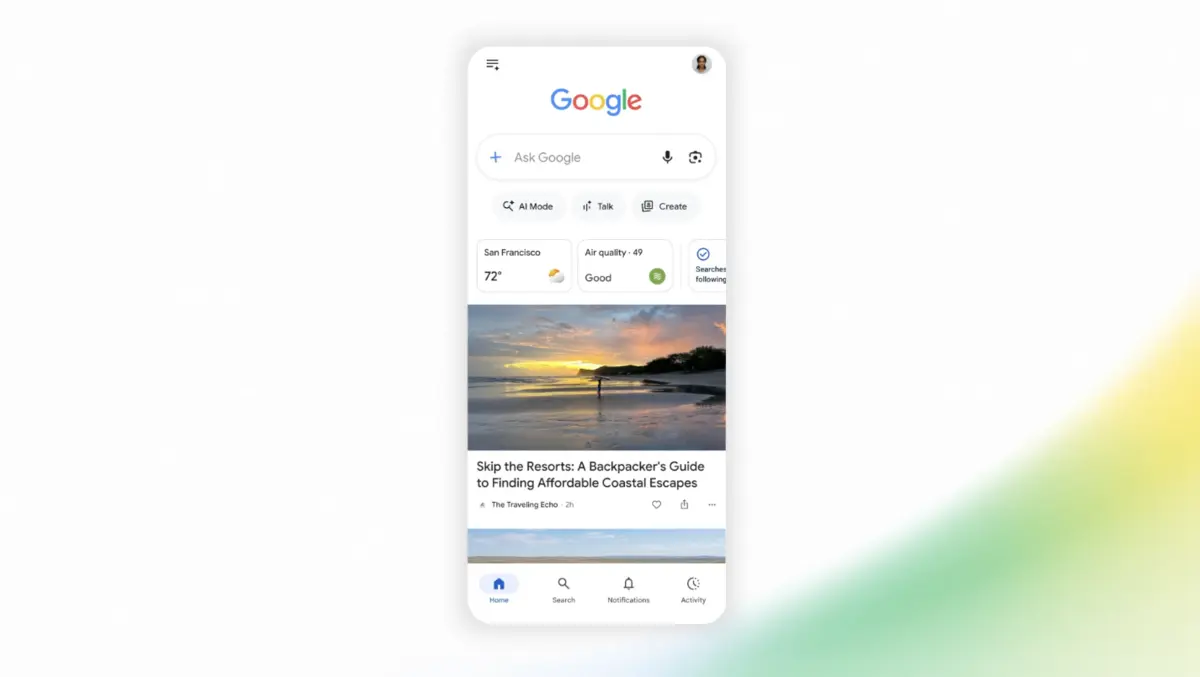
Google overhauls Search with new AI-powered interface
Wed, 20th May 2026 (Today)
Google has introduced a new AI-powered Search interface and expanded AI Mode across Search, calling it the biggest overhaul of the Search box in more than 25 years.
The update makes Gemini 3.5 Flash the default model in AI Mode worldwide and adds a redesigned Search box that accepts text, images, files, videos and Chrome tabs as inputs. Users can also move from AI Overviews into follow-up exchanges in AI Mode on desktop and mobile while keeping the conversation context.
Google said AI Mode has passed one billion monthly users, with query volumes more than doubling each quarter since launch. Overall Search queries reached a record level in the latest quarter.
Search agents
A central part of the update is the introduction of what Google calls search agents. It is starting with information agents, designed to monitor topics continuously and send updates when relevant changes occur.
These agents can track information across web sources including blogs, news sites and social posts, alongside live data in areas such as finance, shopping and sport. Examples include apartment searches and alerts for product launches linked to professional athletes.
Information agents will be released first to Google AI Pro and Ultra subscribers. Google is also expanding agent-based booking tools in Search to tasks such as local activities and services.
In those categories, users can set detailed criteria, and Search will assemble pricing and availability information with links to complete a booking through a provider. In selected areas including home repair, beauty and pet care, users in the US will also be able to ask Google to call businesses on their behalf.
Coding tools
Google is also adding coding-based features to Search through Gemini 3.5 Flash and a system it calls Antigravity. Search will be able to generate responses in different formats, including interactive visuals, tables, graphs and simulations built in real time around a user's query.
That means Search will not only return links and summaries but also create visual explanations and tailored interfaces for specific questions. These generative user interface features will be available to all Search users free of charge later this summer.
Beyond one-off searches, Search will also be able to build persistent dashboards and trackers for ongoing tasks. Google described these as mini apps created inside Search for activities such as wedding planning, moving home or building a fitness routine.
Those custom experiences will draw on live sources including reviews, maps and local conditions such as weather. The mini app feature will launch first for Google AI Pro and Ultra subscribers in the US in the coming months.
Personal context
Google is also broadening access to Personal Intelligence in AI Mode to users in nearly 200 countries and territories across 98 languages, without requiring a subscription. The feature lets users connect services including Gmail and Google Photos, with Google Calendar due to follow.
The move reflects a broader shift in search from retrieving information to carrying out tasks and delivering more context-aware answers. It also puts Google in closer competition with standalone AI assistants that have positioned conversational interfaces as an alternative to traditional web search.
Search remains one of Google's most important products and a major driver of its advertising business, so changes to its interface and underlying technology are closely watched by publishers, marketers and rivals. By embedding more AI functions directly into Search rather than treating them as separate tools, Google is reshaping how users phrase queries, discover websites and complete transactions online.
The redesigned Search box is rolling out in all countries and languages where AI Mode is already available. The conversational handoff from AI Overviews to AI Mode is now live worldwide on desktop and mobile.
On personal data connections, users will decide whether to link apps such as Gmail and Google Photos. Google said the system was designed around transparency, choice and control.