

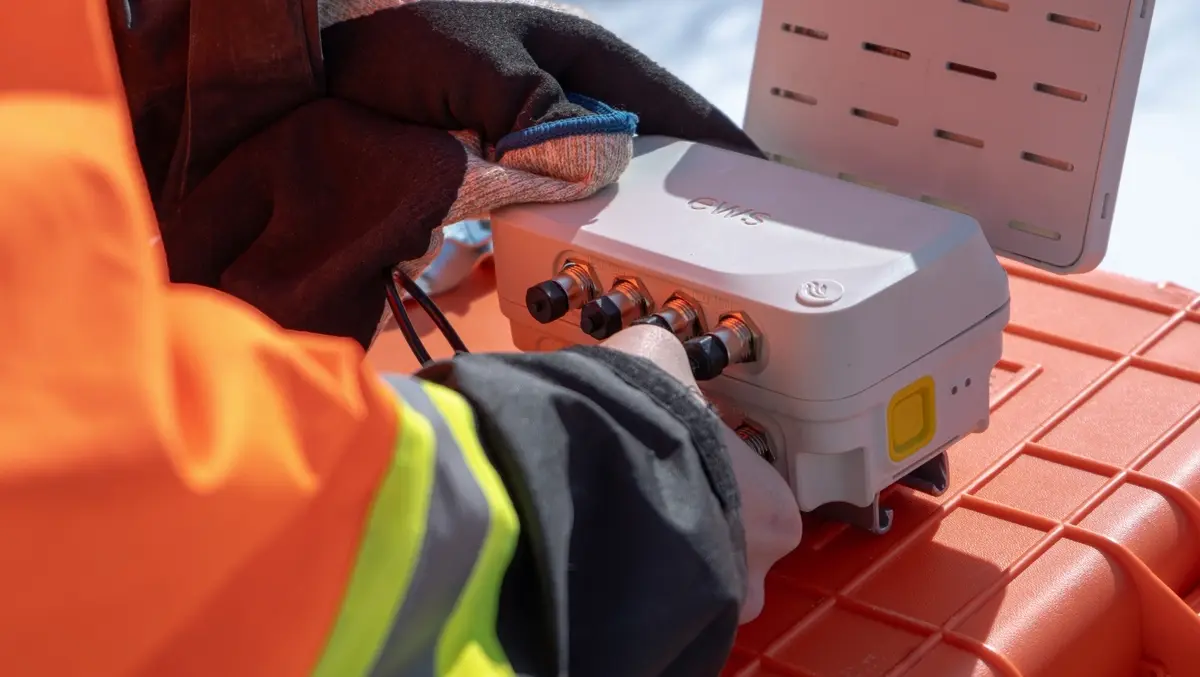
EWS to launch Canadian hub for remote mining monitoring
Sun, 8th Mar 2026
Environmental technology company EWS is establishing a permanent presence in Canada after a year of technical deployments and early wins in the country's remote monitoring market.
The move gives the Western Australia-founded business a new international base. EWS supplies satellite-connected monitoring equipment and software for mining and environmental applications and is backing the expansion with a multi-million dollar investment and a local operating team.
"Canada is the obvious next stage of growth for EWS Monitoring," said Brad Phillips, Founder and Managing Director. "We've been testing the waters there for about a year and had some really good wins and some exciting opportunities come out of that. Now it's time to pull the trigger, set up EWS Monitoring properly and really focus on growing the brand in that region."
EWS has operated for 12 years and employs about 35 staff globally. It has expanded manufacturing capacity in Perth to meet rising international demand and expects headcount to increase as its Canadian operations grow.
Remote monitoring
Canada's mining, oil and gas, dam safety and environmental monitoring sectors include assets in areas with limited infrastructure and harsh seasonal constraints. In the far north, access often depends on short weather windows and seasonal routes such as ice roads. Some sites require boat or helicopter access, which shapes equipment selection, installation planning and maintenance schedules.
EWS's core pitch is a "satellite-first" approach for locations where cellular coverage is patchy or absent. The company began in Western Australia's mining sector, where temperatures can exceed 45 degrees and remote deployments are routine. Its systems were built on the assumption that reliable connectivity would not be available.
EWS's data loggers transmit over satellite and are positioned for long-term, unattended deployment. The platform uses the Iridium satellite network and can also operate over cellular, radio and LoRaWAN, depending on site conditions.
The company also describes its hardware as sensor-agnostic, with data loggers that integrate with third-party groundwater, geotechnical and environmental instruments. Target use cases include mining, oil and gas, dam safety, flood monitoring and permafrost.
Local leadership
EWS has appointed Jason Luty as Market Development Manager, North America, as it formalises its Canadian presence. It describes Luty as an industry leader with experience and relationships in Canada's mining and extraction sectors.
"Having spent years leading sales in the remote monitoring industry, I've seen a wide range of technologies. What impressed me about EWS is how well the product performs in real-world conditions. It's practical, robust, and clearly built by people who understand the field, which made the decision to join an easy one," said Luty.
EWS has also named Jason Riendeau as Canadian Technical Lead. Riendeau said deployability matters in remote conditions where teams have limited time on site and must manage risk.
"As soon as I started working with the EWS telemetry devices, I could see how straightforward they were to deploy. You're not spending hours configuring communications or trying to integrate multiple third-party systems. The unit is installed, powered up, and it begins transmitting immediately. In remote Canadian environments, that simplicity translates directly into time savings, lower risk, and faster deployment," said Riendeau.
Riendeau contrasted satellite-enabled monitoring with approaches that still require staff to retrieve data manually from standalone instruments. "In many cases, organisations are still deploying personnel into remote areas to retrieve data from standalone instruments," he said. "When you model the true cost of sending teams out by helicopter or ATV, the operational expense quickly exceeds the cost of deploying a satellite-enabled device that transmits data continuously. The safety benefits alone are significant, particularly in isolated or environmentally challenging locations."
Extreme conditions
EWS is applying the same product design principles across different environments. In Canada, that includes prolonged sub-zero temperatures, permafrost movement and snow loading. Early deployments have shown consistent performance for battery operation, enclosure integrity and satellite transmission in severe climates, according to EWS.
Phillips said the business designs systems for operating extremes rather than lab conditions. He also pointed to team backgrounds in hydrology, meteorology and geotechnical engineering.
"That helps us develop solutions that are driven by real industry experience, because we genuinely understand what our sector requires rather than forcing solutions that haven't been tested in the field," he said.
Phillips also linked the Canadian push to overlap among large miners operating in both countries. "Many tier-one miners operate in both Australia and Canada," he said. "The technical requirements are comparable, the regulatory standards are high, and the need for reliable, remote monitoring is non-negotiable. We see strong alignment."
"We've built this business carefully over more than a decade," Phillips said. "Canada is a natural next step for us. We're investing properly, putting the right people in place, and building something that will last."