

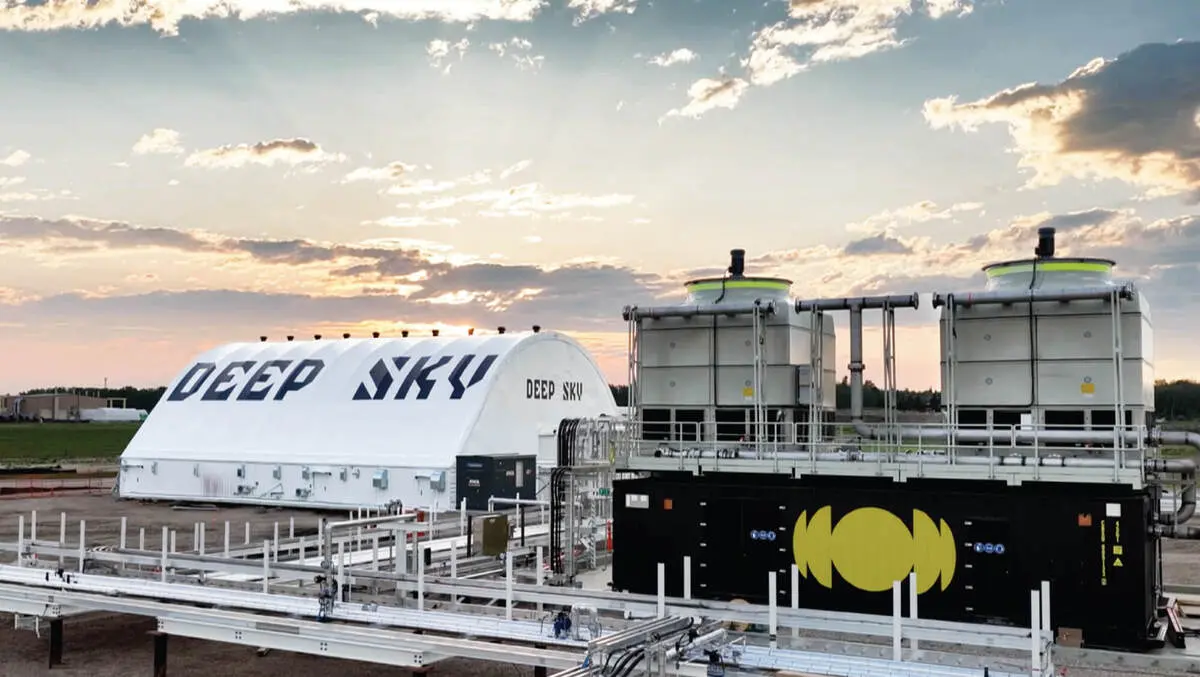
Deep Sky launches North America's first DAC carbon capture facility
Thu, 21st Aug 2025
Quebec-based Deep Sky has launched North America's first underground carbon dioxide storage using direct air capture (DAC) technology at a facility in Innisfail, Alberta.
The project marks a milestone for the Canadian carbon removal sector, with CO2 captured directly from the atmosphere using DAC units built by Sherbrooke-based company Skyrenu. CO2 is then permanently stored underground in rock formations known as saline aquifers.
Deep Sky Alpha, located approximately 120 km outside of Calgary, was established to facilitate the development and testing of carbon removal solutions, allowing technology providers to validate and scale their systems in a real-world environment while generating carbon removal credits.
Alex Petre, CEO of Deep Sky, commented on the importance of the achievement for the Canadian climate technology sector.
"This is exactly what Deep Sky Alpha was built for. A product of Sherbrooke University, Skyrenu's achievement shows that Canadian climate tech can lead on a global stage and that carbon removal is ready to scale today," said Petre.
The facility's DAC unit can remove up to 50 tonnes of CO2 from the atmosphere per year and was selected to participate at Deep Sky Alpha for its potential to deliver low-cost carbon capture.
Gabriel Vézina, CEO of Skyrenu, highlighted the significance of the collaboration in advancing direct air capture deployment and carbon removal efforts.
"Our partnership with Deep Sky is a powerful example of how to accelerate DAC to climate-relevant scale. Deep Sky's ability to integrate the full value chain - from CO2 capture to sequestration - perfectly complements Skyrenu's focus on designing and producing high-performance DAC units. Together, we can deliver impactful projects faster, generate high-quality carbon removal, and set a new benchmark for the industry. This first win proves that we have the model to lead the way in Canada and beyond," said Vézina.
The DAC technology, which originated at Sherbrooke University, is designed for modular deployment and rapid commercialisation.
The accomplishment comes as governments and companies increase investments in carbon capture and removal to progress towards net-zero emissions goals. High-quality carbon dioxide removal (CDR), such as that delivered by this DAC and storage process, is viewed as a crucial element in mitigating the impacts of climate change and meeting future climate commitments.
According to the company's website, Deep Sky Alpha's goal is to remove 30,000 tonnes of CO2 in the first decade.
Last year, the Royal Bank of Canada purchased 10,000 tonnes of DAC credits from Deep Sky over a 10-year period. Microsoft followed with a purchase of the same amount in mid-November 2024.
Last month, the Government of Canada announced more than CAD $21.5 million towards Canadian-made carbon capture, utilisation and storage (CCUS) technologies to advance the energy sector while fighting climate change through clean technology.
Deep Sky is backed by over $130 million in funding from various investors, including Investissement Québec, Brightspark Ventures, Whitecap Venture Partners, OMERS Ventures, BDC Climate Fund, Breakthrough Energy Catalyst, BMO, National Bank of Canada, and more.
Image courtesy of Deep Sky.