


Cursor has begun rolling out Origin, a code hosting service, to users on paid plans. The product is launching in early beta with repository hosting and pull request tools.
Origin brings code hosting directly into Cursor's platform, letting users create repositories, push and pull code with Git, and manage pull requests in the same environment where they work with the company's coding agents. The rollout applies to paid plan users, though Enterprise organisations can be excluded if administrators opt out.
The launch expands Cursor beyond AI-assisted coding into source code management, an area dominated by providers such as GitHub and GitLab. By adding repository hosting, sync tools and review workflows, Cursor is trying to bring code, collaboration and automated coding tools into a single system.
Core tools
At launch, Origin centres on a new Codebase section where users can create and name repositories. When users create their first repository, they also name their codebase, and that identifier becomes part of the address for repositories hosted on Origin.
The service starts with basic source control functions. Users can host repositories on Origin, browse code, and use Git commands to clone repositories or push local projects. Pull requests are built into every repository, with support for reviewing code changes, checking timelines and commits, adding comments and merging changes.
GitHub repositories can also be brought into the system through a sync option. Users connect a GitHub account, select an organisation and choose which repositories to synchronise. Those repositories then appear alongside code hosted directly on Origin, with visual markers distinguishing the two sources.
For synchronised repositories, GitHub remains the main repository for code changes if projects started there. Updates to synced repositories appear in real time in Origin, and users with read or write access can view them in Cursor. Pull request activity also syncs both ways, including comments, reactions and replies.
Workflow link
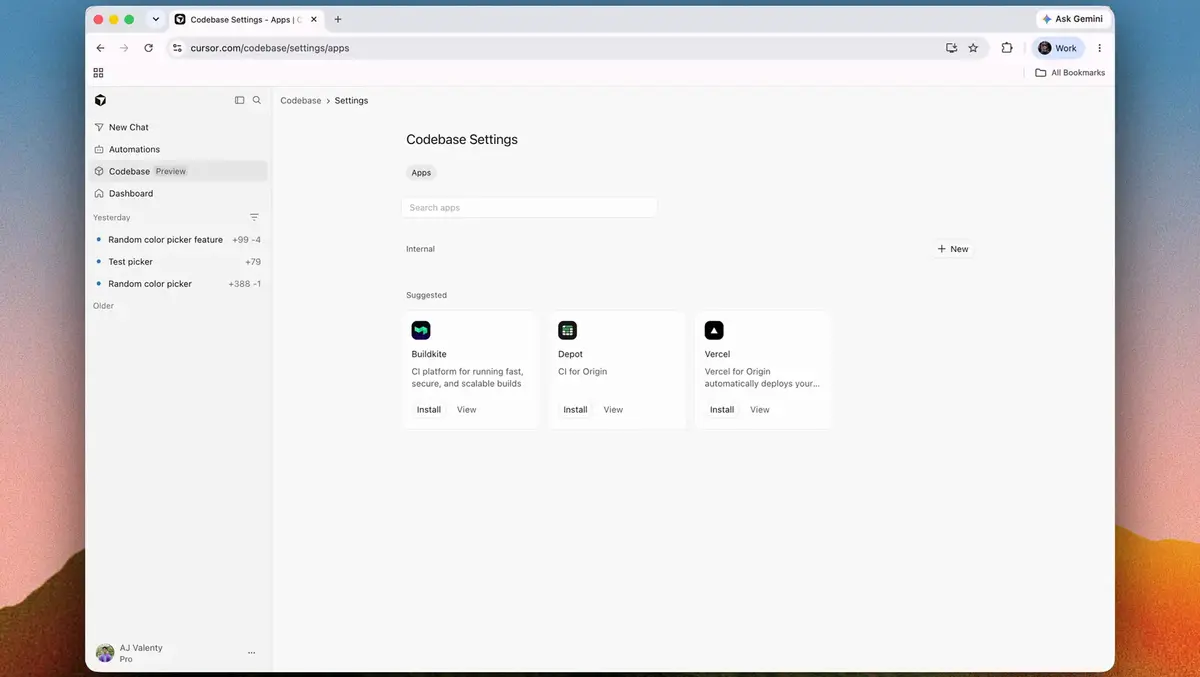
Cursor is also tying Origin to deployment and continuous integration services. Integrations are available with Vercel, Depot and Buildkite through a repository apps section.
Connecting Vercel allows each pull request to generate a preview deployment for testing and comments before code is merged. For continuous integration, Depot and Buildkite can run existing GitHub Actions workflows, while Buildkite can also run its own native pipelines.
Repository settings include controls for access management, visibility into connected apps and status checks for GitHub synchronisation. These administrative features suggest Cursor is aiming to support team workflows rather than limiting Origin to individual developers using coding agents.
Agent focus
A central part of the new service is the link between hosted code and Cursor's AI agents. Users can ask questions about code while browsing repositories, and the agent can answer, make code changes, update pull requests or push a branch.
That approach reflects a broader trend among software tool providers trying to embed AI functions directly into development workflows rather than offering them as separate assistants. Hosting code in the same environment may give Cursor tighter control over how those tools inspect repositories, propose edits and participate in review processes.
Still, the early beta release is limited to basic hosting and collaboration features. More agent-focused functions are expected to follow, indicating that the current launch is an initial step rather than a full replacement for more mature source code platforms.
Cursor is entering a market where developer teams often rely on deeply embedded tooling and established review processes, which may make switching difficult. Its immediate route into that market appears to be interoperability with GitHub, allowing teams to bring existing repositories into Cursor without changing the primary source of truth.
By keeping GitHub as the upstream system for synchronised projects, Cursor reduces the migration burden for teams that want to test its interface and agent tools without moving repositories outright. That may also help position Origin as an additional layer for browsing, reviewing and interacting with code, rather than requiring a full platform change from the outset.
Origin is included in paid Cursor plans during the early beta period, with access available through the platform's new Codebase area.