

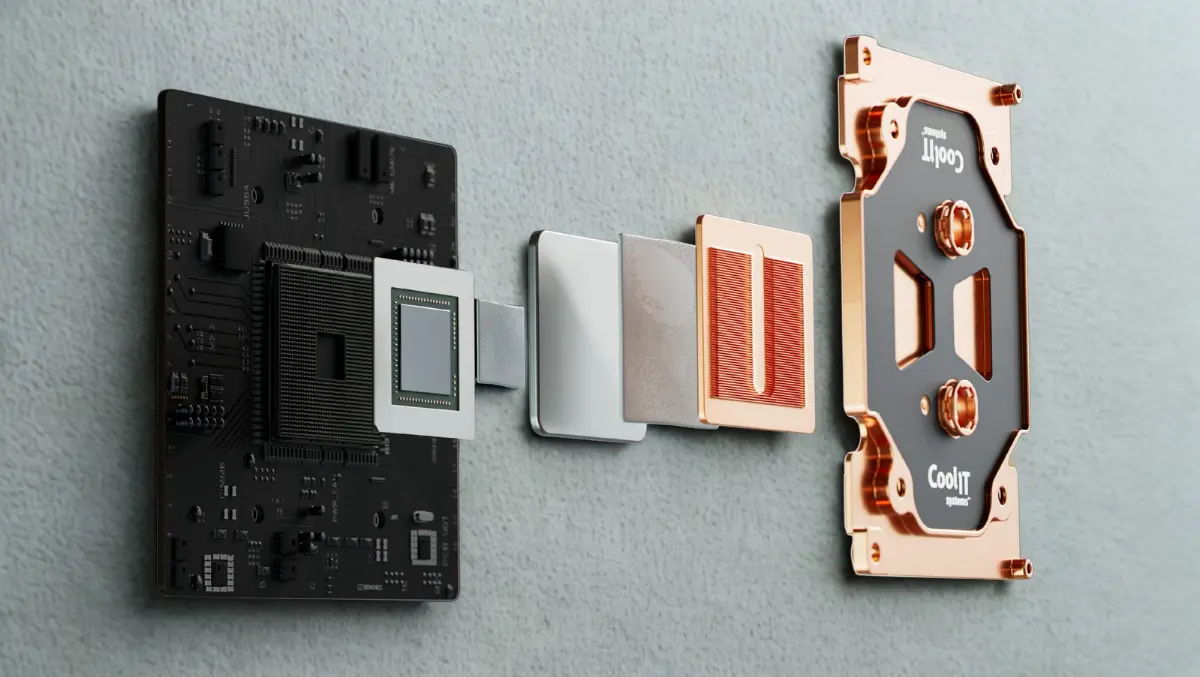

CoolIT Systems has developed a 15kW coldplate for single-phase direct liquid cooling, which it describes as the first of its kind at that thermal level.
The design is a sharp increase from CoolIT's earlier 4kW coldplate, unveiled in 2025. The latest version delivers nearly four times the cooling capacity and is aimed at future generations of GPUs and AI accelerators with higher heat loads.
Direct liquid cooling has become a more prominent part of data centre engineering as AI systems pack more processors into tighter server designs. That has increased pressure on cooling suppliers to show that existing approaches can handle higher circuit density and more demanding chip packaging without a wholesale shift to different thermal architectures.
CoolIT said the 15kW coldplate was validated using standard water-glycol coolant at 1.2 litres per minute per kilowatt. It also said the system delivered thermal performance suited to 45C warm-water cooling environments.
The design uses CoolIT's Split-Flow microchannel architecture. According to the company, it extends the operating range of single-phase direct liquid cooling beyond current AI processor requirements, with cooling headroom of more than 10 times the needs of today's AI GPUs.
Kamal Mostafavi, Chief Technology Officer at CoolIT Systems, said the result supported the long-term case for the approach. "Single-phase DLC is already cooling millions of AI accelerators today. This achievement shows it is also the architecture to cool AI infrastructure well into the future."
He added: "With validated performance at 15kW, CoolIT has proven that single-phase DLC is not only practical to cool millions of the most advanced AI chips today, but ready to cool the coming generations of GPUs and AI accelerators."
The announcement comes as chipmakers and server manufacturers continue to assess how best to manage rising thermal loads in AI clusters. Air cooling remains common across much of the data centre market, but liquid cooling is taking a larger role in high-density installations, where heat output is rising faster than traditional approaches can comfortably manage.
Industry analysts said the significance of the development lies less in immediate deployment at 15kW than in whether suppliers can show a credible engineering path as processor power rises. The debate has centred on whether single-phase systems can continue to scale or whether more operators will need to adopt more complex alternatives.
Dylan Patel, Chief Executive Officer of SemiAnalysis, said the work would feed into that assessment. "AI accelerator innovation depends on cooling architectures that can keep pace with rising circuit density and packaging complexity."
He added: "CoolIT's work demonstrates that single-phase DLC has a clear path forward, giving both the semiconductor and data centre industries greater confidence in the cooling architectures they can invest in."
Market direction
Cooling has become an increasingly strategic part of AI infrastructure design as customers seek to avoid stranded power and floor space in data centres. The push towards warm-water cooling also reflects the economics of operating large AI estates, where operators want to limit energy consumed by chilling equipment and improve total heat capture within the server.
CoolIT pointed to wider industry backing for that direction, noting that Nvidia has publicly highlighted single-phase direct liquid cooling with 45C supply temperatures as part of its next-generation AI platform plans. That stance has reinforced the role of factory-integrated liquid cooling in server design, particularly for systems built around dense GPU configurations.
The company said it is also working on coldplates for additional server components and on designs intended to target the hottest areas within advanced AI chips. Those efforts aim to increase the amount of heat removed from complete systems rather than only the main processor package.
CoolIT supplies liquid cooling hardware to server makers, cloud providers, and data centre operators. According to the company, its technology is used in seven of the world's 10 largest supercomputers, as well as at a number of hyperscale cloud sites.