

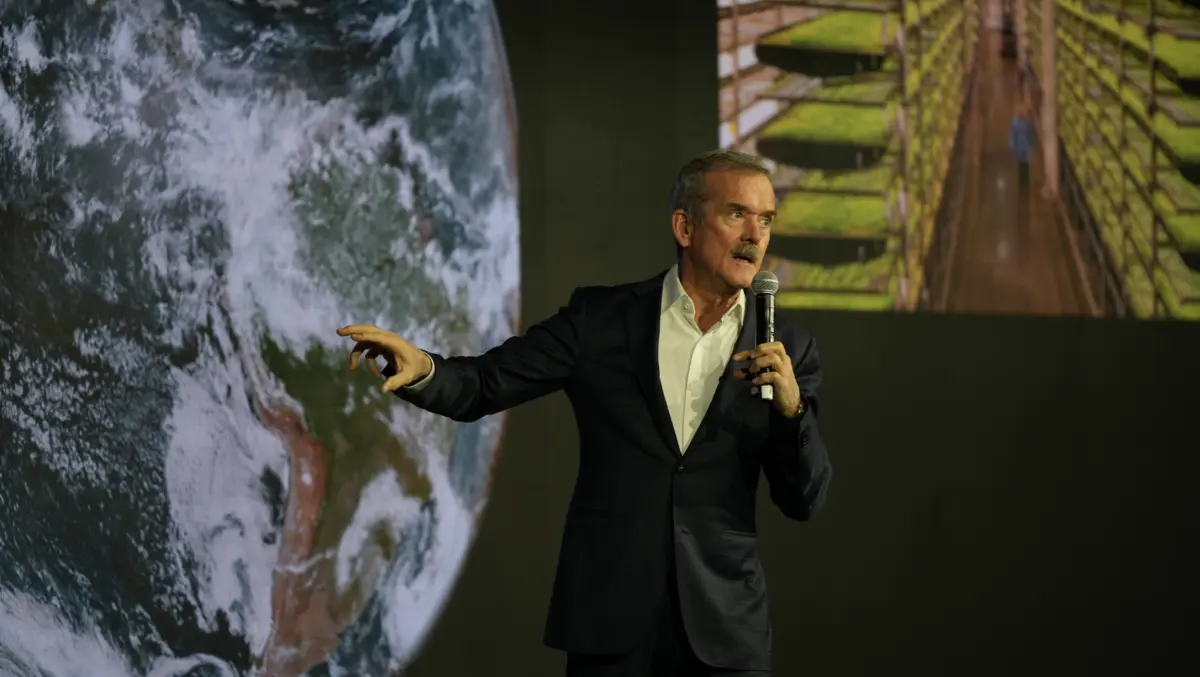
Chris Hadfield on fusion, AI, human ingenuity for the future
Fri, 28th Nov 2025
Retired astronaut Colonel Chris Hadfield has been to space three times, tested military fighter jets and commanded a $150 billion galactic outpost: the International Space Station (ISS).
Since his return to Earth, Hadfield has written multiple books and engaged audiences with the inspiring story of his perseverance and dedication to rigorous preparation and building competence in all aspects of life and work.
While his range of talents is well known (his ISS performance of David Bowie's Space Oddity has amassed more than 50 million views on YouTube), Hadfield is also an active tech investor, with a particular focus on companies tackling external risks, including environmental impact.
"When I landed from my third space flight, and I crawled out of the ship, I sort of thought, what am I going to do for the remaining 35 years of my life? And it's a question I think you should all ask yourself," Hadfield said to TechDay Canada at Info-Tech Research Group's event in Montreal.
"I just set myself the fundamental litmus test of, does this somehow contribute to improving the quality of life for as many people as possible in a sustainable way? Does this fit into that mould to improve the quality of life for as many people as possible in a sustainable way?
Hadfield said the world is entering a period of geopolitical uncertainty but argues that human inventiveness and advances in sustainable energy offer grounds for confidence in long-term progress.
"Energy is the core of everything. We all take it for granted, and here in Quebec, there's a lot of hydroelectric, but in a lot of the world, there's no natural, easily harnessable energy," said Hadfield. "So finding sustainable ways to generate power, to me, is one of the biggest challenges of our age."
Hadfield serves on the board of advisors for biotech firm BioHarvest Sciences and is an angel investor in Kitchener-based food waste-to-bioplastic manufacturer Alt Tex, among other sustainable organisations.
In Montreal, he highlighted China's rapid expansion of solar generation. According to a report earlier this year by Lauri Myllyvirta, a senior fellow at the Asia Society Policy Institute, China installed 93 gigawatts of solar capacity in May. A report from Canada's Renewable Energy Association last year stated that 24 gigawatts of wind, solar, and energy storage capacity were installed across Canada.
"We're making big gains, but everything takes time to adjust, and we've got a huge petroleum-based infrastructure that we have to slowly transition from," said Hadfield, referring to Canada's total energy supply. "We can't suddenly shut off the power."
He added that fusion remains the most significant long-term opportunity. He mentioned Massachusetts-based company Commonwealth Fusion Systems as leading the world right now with a practical solution.
The company is developing a plasma energy system that produces more energy than it consumes, making it the first net-energy magnetic fusion device. While Commonwealth Fusion has crossed the milestone of constructing its facility, it has yet to insert the first plasma into its device, which is expected later next year.
Rapid innovation, global travel and decentralisation make it harder for societies to sustain periods of stability. Hadfield argued that the world population will plateau at around 10 billion people. According to the Colonel, he is looking forward to how humans will imporve living standards using their inventiveness.
"If you look at us, we don't run very fast in the animal kingdom. We don't have the biggest claws, we aren't the most muscular. We don't have the biggest fangs. We can't fly. We're not all that good at swimming. All we've really got going for us as a species is our ability to imagine things that don't exist yet."
Speaking on the future of energy, he said that clean, sustainable power could revolutionise industries and improve the quality of life for 10 million people, with AI offering a path to achieving it.
"We need to take advantage of artificial decision making and machine decision making, just as the Industrial Revolution relieved us from animal and manual labour, artificial intelligence relieves us of all of the mundane work in decision making. We've got to figure out how to integrate that into society"