

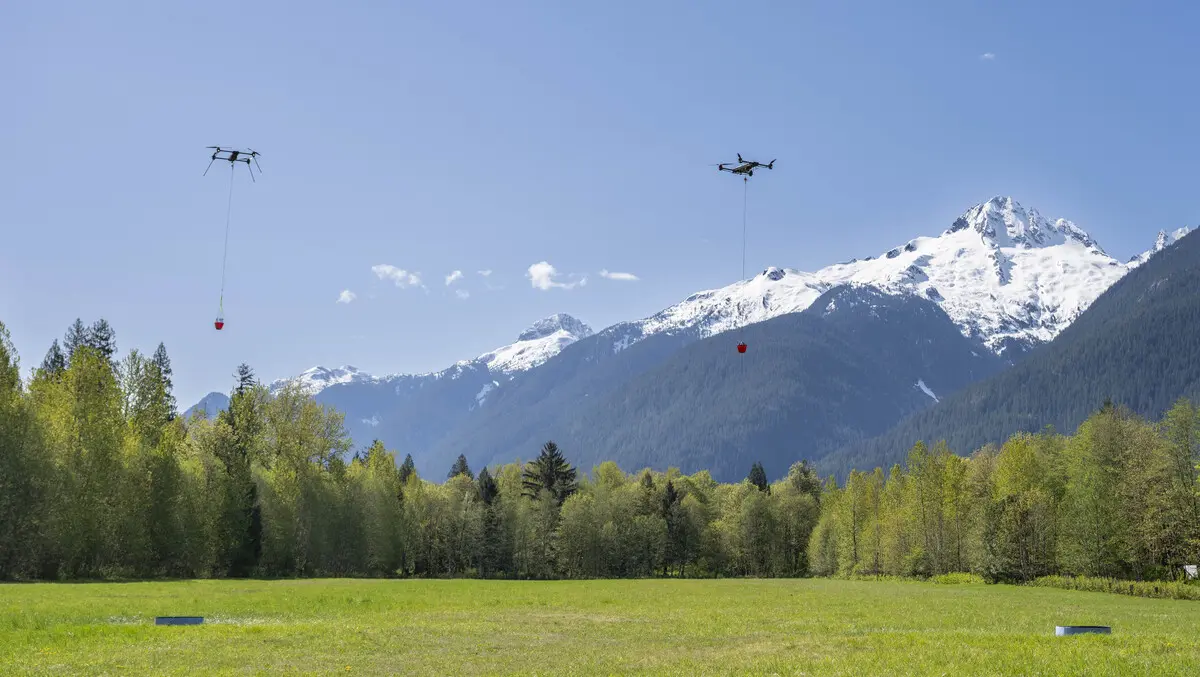
B.C. startup drone swarm tech wants to target wildfires faster
Wed, 4th Mar 2026
In 2023, as wildfires tore across British Columbia in the worst season on record. Alex Deslauriers watched a wall of flame descend on his community from across Gun Lake, about 200 kilometres north of Vancouver.
On the other side of the water, a fire tornado uprooted three-foot-diameter trees and hurled them "like they were matchsticks." Deslauriers watched with his partner, Melanie Bitner. By nightfall, the water bombers that had skimmed the lake all day were grounded for safety. The fire kept moving.
That moment, the silence of aircraft at night while the blaze advanced, became the catalyst for FireSwarm, a Squamish-based startup developing ultra-heavy-lift drone swarm programs for wildfire suppression and, increasingly, defence applications.
"We looked at the archaic way in which aircraft were picking up water during the day, dropping water on the fires," Deslauriers said. "Then nothing would happen in the nighttime hours. It just left us thinking: why is innovation not keeping up with the pace of the problem?"
Deslauriers, an aerospace engineer with 25 years' experience implementing complex systems on military jets and commercial airliners (including a decade at Boeing), co-founded FireSwarm alongside David Thanh and Bitner. The company's "North Star," he said, is to "bring innovation to wildfire."
Bitner's family lost a multi-generational property near Gun Lake in the 2023 fires. Historical buildings, heirlooms and her father's primary residence were destroyed. Nearly three years on, he has yet to be fully rehomed.
"We watched that evening the fire come down the mountain," Bitner said. "We knew there was no aircraft fighting it. The crews on the ground didn't have the support they needed."
The founders' frustration coalesced around a simple question: could drones do what crewed aircraft could not - operate persistently, including at night, and respond earlier?
Thanh, FireSwarm's Chief Operating Officer, brought a decade of wildfire service experience and a background in emergency management. His initial reaction to the heavy-drone solution was sceptical, as many drones can not support substantial water weight to combat raging blazes.
"A heavy lift drone is maximum take-off weight of less than 25 kilos. You can't fight a forest fire with 10 litres of water," he explained. "Then [Alex] said, 'Well, what if we had bigger drones that could carry 200 or 300 litres of water?' Now you're on to something. So we started looking around the world for aircraft that would be able to do this."
The team partnered with Swedish manufacturer ACC Innovations, whose ThunderWasp drone can carry up to 300 litres of water. FireSwarm integrates its own fire mission kit and proprietary software onto such platforms, positioning itself as an end-to-end solution provider rather than simply a hardware reseller.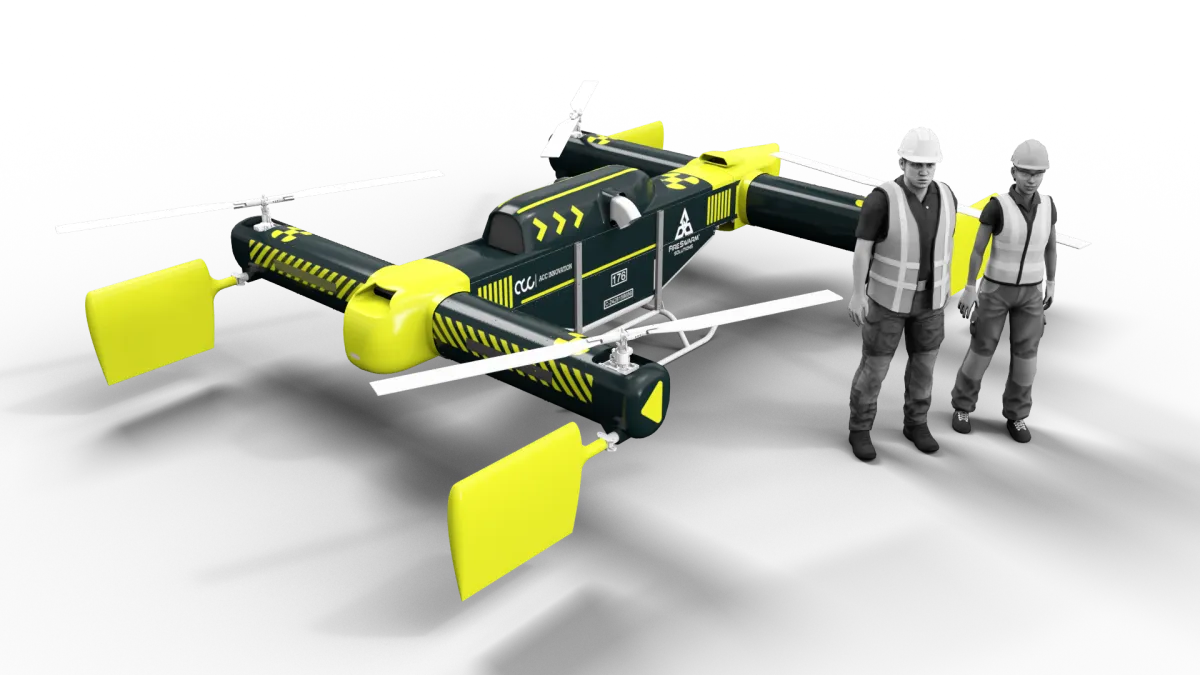
The company's offering includes autonomous flight software, consulting to integrate the systems into existing wildfire operations, training, and maintenance management.
The core technological bet is on coordinated swarms operated by a single human.
"We create the software that allows a single operator to monitor multiple drones in dynamic missions," said Thanh. "Fire is dynamic. It moves. You might need to change tactics based on where the fire is moving to."
Initially, the system is designed to collect data by combining satellite inputs, onboard sensors, and fire-behaviour modelling to understand the effectiveness of water drops under varying conditions. Over time, the company aims to build sufficient datasets for increasingly autonomous suppression.
"The ultimate goal is that we have these units pre-positioned all over the country," Thanh said. "When a fire breaks out, they're able to completely autonomously take off and suppress the fire at its incipient stage."
A single drone carrying 300 litres cannot match the payload of a Black Hawk helicopter. But a coordinated swarm, the founders argue, could begin suppression earlier, operate longer, and function in conditions unsafe for crewed aircraft.
While wildfire remains the company's stated mission, defence has emerged as a critical accelerant.
This year, FireSwarm will join a cohort under NATO DIANA, a program designed to fast-track dual-use technologies into defence adoption. Out of over 3,600 global applicants, the company was one of 150 selected.
Participation grants access to 200 test sites across 32 nations and includes an operational exercise in Latvia alongside the Canadian Armed Forces. There, FireSwarm will test logistics delivery and casualty evacuation concepts using heavy-lift drone swarms.
The casualty evacuation use case reflects changing battlefield realities, Thanh said.
"The Red Cross has turned into a target," he noted. "War fighters are staying in the field sometimes for days waiting for evacuation."
The company envisions drones equipped with long lines (similar to helicopter rescue systems used in search and rescue) flying into contested areas to extract injured personnel without risking aircrews.
For Deslauriers, defence is less a pivot than a pathway.
"From the beginnings of aviation, most of the R&D has been spent by defence organisations," he said. "This dual track is critical. It allows us to prove our solution and get data available to the market for commercial use."
Interest from provincial governments and wildfire agencies is high, the founders say, but funding and procurement cycles remain slow. Defence partnerships offer faster validation and operational testing, while reinforcing the company's dual-use positioning.
FireSwarm's systems are not currently flying live wildfire suppression missions. But the company reports interest from communities in British Columbia (including Kelowna) and says it is in ongoing discussions across Canada.
In Squamish, where all three founders live, wildfire remains a tangible threat. Thanh has been under evacuation alert multiple times, including after a lightning strike ignited a blaze less than a kilometre from his home.
"We're all moving into these interface zones to try and get out of the city," he said. "And that's putting us at increased wildfire risk."
For FireSwarm's founders, the convergence of climate change, expanding wildland-urban interfaces and evolving combat has created both a market opportunity and a moral imperative.
From B.C. lakes to NATO test sites in Europe, FireSwarm is betting that swarms of autonomous aircraft can shift the economics and physics of both disaster response and defence.