

AI models help Canadian farmers turn data into decisions
Wed, 28th Jan 2026
Agriculture accounts for seven per cent of Canada's GDP. As global food demand increases, there is a growing need to expand the industry efficiently and sustainably.
Farhad Maleki is a computer scientist and an Assistant Professor at the University of Calgary, whose research on AI models to address complex, real-world challenges is guided by his upbringing on a chickpea farm on the mountainous terrain of western Iran.
His research examines the processing of visual information from fields. Using stationary cameras, drones, and satellite imagery, new technologies can monitor fields at larger scales, thereby changing how farmers perform various field activities. Maleki argues that this can help identify crop stress earlier and identify specific issues for targeted treatment to prevent significant crop loss. The same can be applied to livestock to detect early signs of disease.
"AI transforms many areas in a way that it will be completely different but farming is one of them that perhaps will be significantly transformed," says Maleki. "The level of transformation will be, I would say, bright, in a way, because it creates a lot of synergy. We also have a growing population that needs more food. So those are areas that I would say, AI and agriculture can unite."
Maleki further explores the use of synthetic data to predict precision agriculture even when there is a lack of real data.
By creating simulated (synthetic) data, researchers can initially train models on artificial examples that capture the basic structure of plants or animals. Then, using a smaller real dataset, they refine these models to achieve high performance.
He emphasised that synthetic data lowers the cost and time required for data collection, which is vital as most farmers have a limited farming window, usually less than one-third of the year.
"They don't start from scratch. They start from that level, using the small amount of real data, we can build a high performing model. So that's one important area of research," he says.
Time is of the essence for Canadian farmers. Producers are under pressure from recent rising input costs such as fuel and feed, paired with unpredictable weather patterns.
Farm Credit Canada (FCC), the federal Crown corporation that provides business support to the agriculture sector, operates more than 100 offices across farming communities nationwide. While traditionally known for lending, FCC has expanded its digital offerings in recent years as farms generate unprecedented volumes of operational data.
Mohamad Yaghi, FCC's Vice President of Innovation Hub and AgExpert, also grew up on a farm. HIs parent still grow grapes and olives in Lebanon to this day, where he says digital tools are gaining traction. A perspective that he shares with his role, helping farmers adopt these tools in Canada.
Yaghi and his team now assist farmers in using software to improve their yields and finances.
AI plays a central role in converting raw agricultural data into actionable insights. Through FCC's agExpert software platform, used by more than 27,000 producers nationwide, machine learning and decision optimisation tools already support accounting, field planning, and financial modelling.
Modern agricultural operations now produce massive datasets from tractors, soil sensors, weather systems and barn equipment. A single pass across a field can generate megabytes of data, while a full growing season can result in petabytes of information collectively. Making that data usable has become one of the sector's biggest challenges.
Yaghi says a major focus in the big data farming era is the creation of "digital twins" - virtual representations of farms that allow producers to model outcomes before making costly decisions, such as land purchases, equipment investments or crop changes. By reducing friction in planning, the tools are intended to help farmers improve margins and operational resilience.
Last year, FCC launched Root AI, the organisation's large language model targeted at helping farmers make sense of years of data from many-hundred-page-long crop guides to scenario building.
"Oftentimes it's really helpful for a farmer to have a lot of context before entering a [financing] meeting, because they can ask better questions then," says Yaghi. "I would say there's two lines of knowledge - the first line where LLMs come in handy, and then that second line where there is experts can provide more custom to spoke information."
Since its launch in July 2025, the tool has recorded more than 20,000 conversations, with early indicators suggesting several thousand producers have already engaged with it. FCC reports approximately six per cent month-over-month growth in usage during its initial rollout.
Yaghi says that producers ask questions about crop management, livestock care, grant eligibility, and scenario planning. In some cases, the system has been used to provide guidance during emergencies, such as responding to injured animals, while in others it helps farmers evaluate financial trade-offs tied to expansion or capital purchases.
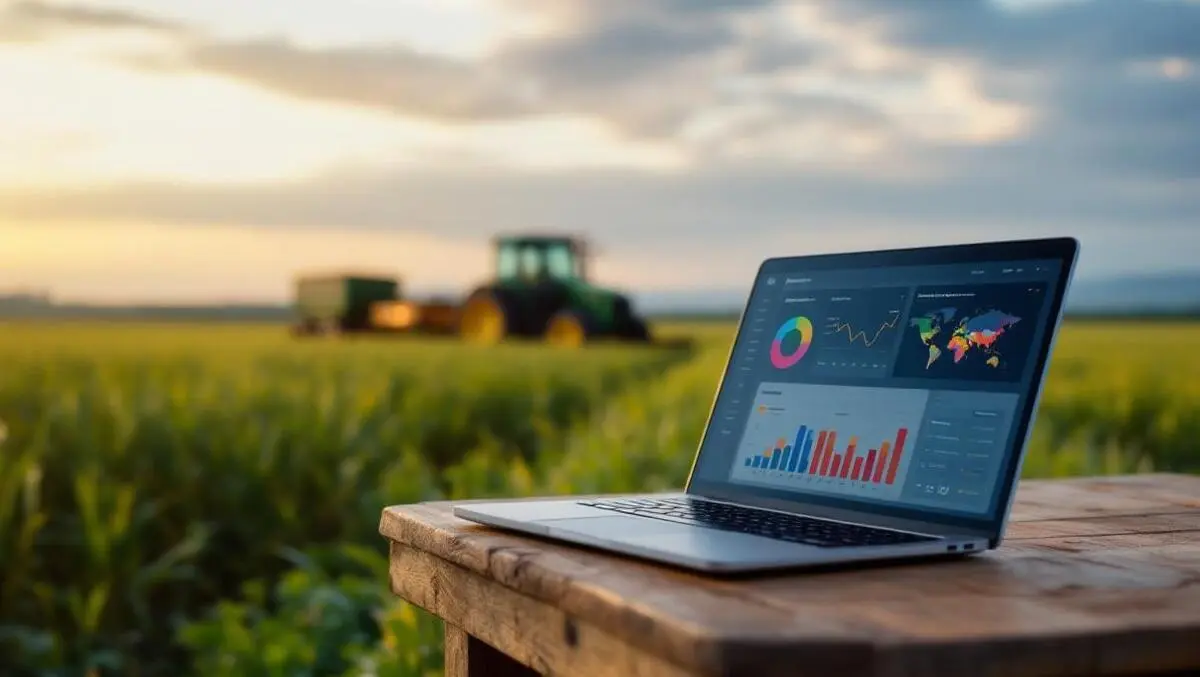
While the image of AI in agriculture often centres on autonomous machinery, the transformation underway is far quieter. It is happening in dashboards, forecasts and digital assistants - tools designed not to change what farming is, but to help producers navigate a world that is becoming more complex every season.
"The contribution of AI for agriculture is expanding beyond monitoring fields or livestock. now we have colleagues that actually are Using they use AI to breed new seeds that are tolerant for drought, or high salinity," adds Maleki. "I want to emphasise how this expansion translates to opportunities for our innovators and our researchers and also for Canadian investors."