


AI, cost pressures reshape observability in new survey
Wed, 18th Mar 2026.webp)
Grafana Labs has published results from its fourth annual Observability Survey, highlighting strong interest in using AI in operations, continued pressure from tool and data complexity, and a sustained preference for open source and open standards.
The study drew 1,363 responses from engineers, site reliability engineers, and technology leaders across 76 countries. Grafana Labs collected the data through online outreach and industry events between October 2025 and January 2026.
Observability tools collect and analyse telemetry such as logs, metrics, and traces. Teams use the data for incident response, performance management, and reliability work. The latest survey suggests the category is expanding beyond technical operations into business monitoring.
Half of respondent organisations said they now use observability tools to track business-related metrics, which Grafana Labs linked to a broader shift toward centralised platforms and more mature operating practices.
AI expectations
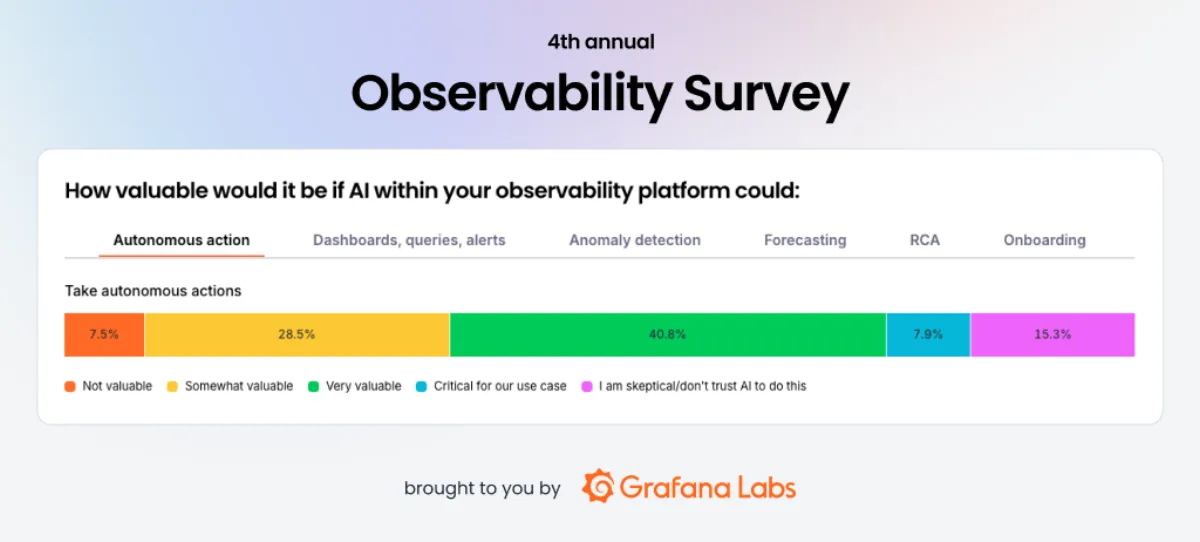
AI ranked highly across several proposed observability use cases. Some 92% of respondents said they see value in AI helping surface anomalies and issues before they cause downtime. The same share supported AI for generating dashboards, alerts, and queries, while 91% endorsed AI for forecasting and help with root cause analysis.
Support fell when respondents were asked about autonomous actions. While 77% backed AI taking actions on their behalf, 15% said they do not yet trust AI to act for them, and 8% said they see no value in using AI for this.
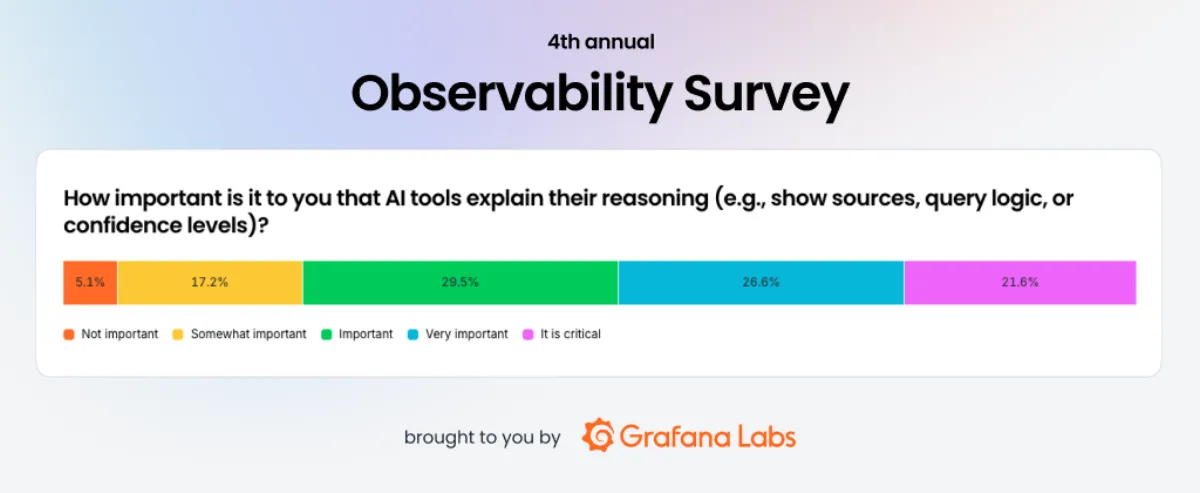
Respondents also raised concerns about how AI is introduced into existing workflows. The most commonly cited barrier to adoption was "too much manual input of required context", selected by 26%. In a separate question, 95% said it is important for AI to show its reasoning.
Grafana Labs linked the results to a focus on transparency and workload reduction. "The survey is clear: AI belongs in the observability workflow, autonomy is the next frontier, and explainability is the price of admission," said Marc Chipouras, VP of Emerging Products at Grafana Labs.
Costs and SaaS
The survey suggests the economics of observability are tightening. Cost was the most important tool-selection criterion for the third year running, cited by 65% of respondents. Ease of use followed at 49%.
Half of respondents expect their organisations to spend more on observability in the next year. The most common reason was broader adoption, selected by 63% of those expecting higher spend. Another 31% pointed to expectations of higher return on investment, while a quarter cited vendor price increases.
Among respondents expecting to spend less, 37% said more efficient operations drove that view. Grafana Labs framed this as evidence that spending decisions are increasingly tied to measurable outcomes rather than expansion alone.
Software-as-a-service adoption rose again. Half of respondents said they use SaaS for observability in some capacity, up from 43% in the prior year's survey. The share using SaaS exclusively reached 17%, compared with 10% in 2024.
Complexity persists
Despite increasing investment, operational complexity remains a central concern. When asked about their biggest observability concern, 38% selected complexity and overhead. Signal-to-noise challenges followed at 34%, with cost at 31%.
Alert fatigue stood out as the leading obstacle to faster incident response. It was cited by 30% of respondents, almost double the next most common response, according to the survey summary.
Centralised observability emerged as a common response to these pressures. Some 77% said centralised observability has saved their organisation time or money. The survey also linked centralisation with internal satisfaction: 61% of teams with mature, centralised practices reported satisfaction with internal operations, compared with 53% using siloed setups.
Respondents also reported progress in unifying infrastructure and application observability, with 46% saying they have unified the two in full production.
Open standards
Open source and open standards continued to feature heavily in observability strategies. Some 77% said they are important to their approach, with 61% calling them "essential" or "very important".
Grafana Labs highlighted ongoing investment in Prometheus and OpenTelemetry. Almost two-thirds of organisations (65%) reported investing in both. Overall investment levels were close, with 77% investing in Prometheus and 76% investing in OpenTelemetry.
The data also pointed to growing momentum for OpenTelemetry. Some 35% of respondents said they are building proofs of concept or actively investigating OpenTelemetry, compared with 18% for Prometheus. More respondents reported increased investment over the past year in OpenTelemetry (47%) than in Prometheus (42%).
According to the findings, OpenTelemetry is now in broad use across metrics (57%), traces (50%), and logs (48%). Respondents cited ease of adoption (41%) and the freedom to switch vendors (37%) as the top reasons for using it.
Grafana Labs also noted that the split between self-managed and SaaS users shapes concerns. Self-managed teams were more likely to cite complexity as their top issue, while SaaS users were more likely to cite cost. The company linked this to shifting procurement and operating models as teams weigh staffing effort against service fees.
The results add detail to a broader industry debate about how AI features should present decisions and reduce operational overhead, while vendors face pressure to justify spend amid a shift toward managed services and open standards.
"Practitioners want trustworthy AI that reduces toil and helps them move faster," Chipouras said.